 Seattle
 Signs Your Roof Is Telling You It's Time
Most Seattle homeowners don't wake up one day and decide to replace a roof. It's a slow accumulation of small warnings that eventually add up to a decision. Knowing what those warnings look like can save you from an emergency tarp job in the middle of a January atmospheric river.
- Shingles that are cupping, curling at the edges, or missing granules (you'll see grit collecting in gutters and downspouts)
- Dark streaking or thick moss growth that keeps coming back within months of cleaning
- Daylight visible through the attic roof deck, or damp insulation after a heavy rain
- Sagging rooflines, especially along ridges or valleys
- Granule loss heavy enough that the shingle mat (the fibrous layer underneath) is exposed
- Flashing around chimneys, skylights, and vents that's rusted, lifted, or cracked
- Interior ceiling stains that reappear after every storm, even after "fixing" the leak once
Any one of these on its own might just mean a repair. Several at once, especially on a roof past the 18-20 year mark, usually means it's time to start budgeting for a full replacement rather than chasing leaks one at a time.
How Long Should a Roof Last in Seattle's Climate
Manufacturer lifespan ratings are written for a national average, not for King County. A 30-year architectural shingle rated for a dry climate will often fall short of that mark here simply because our roofs almost never fully dry out between rain events. Constant moisture, shaded lots under mature evergreens, and a long moss season all shorten the practical service life of most roofing materials compared to their catalog numbers.
As a rough local guide: standard three-tab asphalt shingles tend to perform for 12-18 years here rather than their rated 20-25. Architectural (dimensional) asphalt shingles often make it 20-25 years with regular maintenance. Metal roofing and quality cedar shake, properly installed and maintained, can push past 40-50 years. These are ranges, not guarantees — sun exposure, tree cover, attic ventilation, and how well the roof was installed in the first place all move the number up or down.
What Shortens a Roof's Life Here Specifically
Poor attic ventilation is the quiet killer of Pacific Northwest roofs. Trapped heat and moisture in the attic cook shingles from underneath, while condensation on the roof deck promotes rot that you won't see until you're up there replacing plywood. A roof that looks fine from the street can be failing from the inside if the soffit and ridge venting was never sized correctly.
Moss, Moisture, and the Marine Air Factor
Seattle's roofing challenges come from a specific combination of conditions: long stretches of driving rain, mild temperatures that never freeze the moss out, and salt-laden marine air near Puget Sound that accelerates corrosion on metal fasteners and flashing. None of these alone would be a big deal. Together, they're why roofs here age differently than roofs in drier or colder parts of the country.
Moss is more than a cosmetic nuisance. As it establishes on shingles, its root structures lift tabs and hold water against the roofing material, which accelerates granule loss and can work moisture under the shingle edge. Left unchecked for a few seasons, moss-related damage can shave years off a roof's life. Zinc or copper strips near the ridge, combined with periodic soft washing (never pressure washing, which strips granules), are the standard defense — but they manage the problem, they don't eliminate the underlying climate conditions that cause it.
Salt air is less discussed but real for homes closer to the Sound: it speeds up corrosion on exposed steel fasteners, gutter hardware, and lower-grade flashing. It's one more reason material and fastener quality matter more here than in inland climates.
Roofing Material Options: A Side-by-Side Look
There's no single "best" roofing material — the right choice depends on your budget, roof pitch, tree cover, and how long you plan to stay in the home. Here's how the common options compare for a typical King County home.
| Material | Typical Local Lifespan | Moss/Moisture Resistance | Relative Cost |
|---|---|---|---|
| 3-Tab Asphalt Shingle | 12-18 years | Fair — needs regular cleaning | Lowest |
| Architectural Asphalt Shingle | 20-25 years | Good with proper ventilation | Moderate |
| Metal (standing seam) | 40-50+ years | Excellent — sheds moss and moisture | High |
| Cedar Shake | 25-35 years | Requires diligent maintenance | High |
| Concrete/Clay Tile | 40-50+ years | Good, but heavy — needs structural check | Highest |
Architectural asphalt remains the most common choice locally because it balances upfront cost with a service life that holds up reasonably well to our conditions, provided the ventilation and underlayment are done correctly. Metal has grown more popular in the last decade for homeowners planning to stay long-term, since its moss resistance and lifespan offset the higher initial price over time.
What Roof Replacement Actually Costs
Roofing costs vary enough by roof size, pitch, and condition that any single number is misleading. What's more useful is understanding the factors that move your quote up or down.
| Factor | Why It Matters |
|---|---|
| Roof size (squares) | Priced per 100 sq. ft.; the single biggest cost driver |
| Pitch and accessibility | Steep or multi-story roofs require more safety equipment and labor time |
| Layers to remove | Tear-off of existing layers adds labor and disposal cost |
| Decking condition | Rotted plywood found underneath adds material and labor beyond the base quote |
| Material choice | Asphalt, metal, and tile carry very different material costs per square |
| Ventilation upgrades | Adding proper soffit/ridge venting protects your investment but adds cost |
| Flashing and skylights | Chimneys, skylights, and valleys all add labor complexity |
A straightforward tear-off and reroof on a single-story home with good decking will land toward the lower end of any contractor's range. A steep, multi-valley roof with rotted sheathing discovered mid-project will land toward the higher end — which is exactly why a thorough inspection before the quote matters more than a fast estimate.
Permits, HOA Rules, and King County Considerations
Most full roof replacements in Seattle and unincorporated King County require a building permit, and reputable contractors handle that paperwork as part of the job rather than leaving it to the homeowner. If you're in a neighborhood with an HOA or historic overlay, check whether there are material or color restrictions before you fall in love with a particular product — this comes up more often with visible-from-street materials like metal roofing or non-standard shingle colors. Steep-slope lots common in many Seattle neighborhoods can also affect crew safety requirements and, in turn, labor cost.
Hiring a Roofing Contractor: What to Check
Roofing draws more than its share of storm-chasing outfits that show up after a windstorm, take a deposit, and disappear. A little vetting up front avoids most bad outcomes.
- Washington State contractor license, current and in good standing (verify it directly with L&I, not just take their word for it)
- General liability insurance and worker's compensation coverage — ask for a certificate, don't just accept a verbal assurance
- A physical local address and a track record in the Seattle area, not just a phone number and a rented truck
- A written estimate that itemizes tear-off, decking repair contingency, materials, and disposal — not a single lump number
- Manufacturer certification if you're installing a product with an enhanced warranty tier
- A clear plan for protecting siding, gutters, and landscaping during tear-off
- References or a portfolio of completed local work you can actually look at
Be especially cautious with any contractor pressuring you to sign the same day, quoting a price dramatically below everyone else's, or asking for full payment upfront. These are the classic signs of a crew that won't be around if something goes wrong under warranty.
Roof Replacement and the Rest of Your Exterior
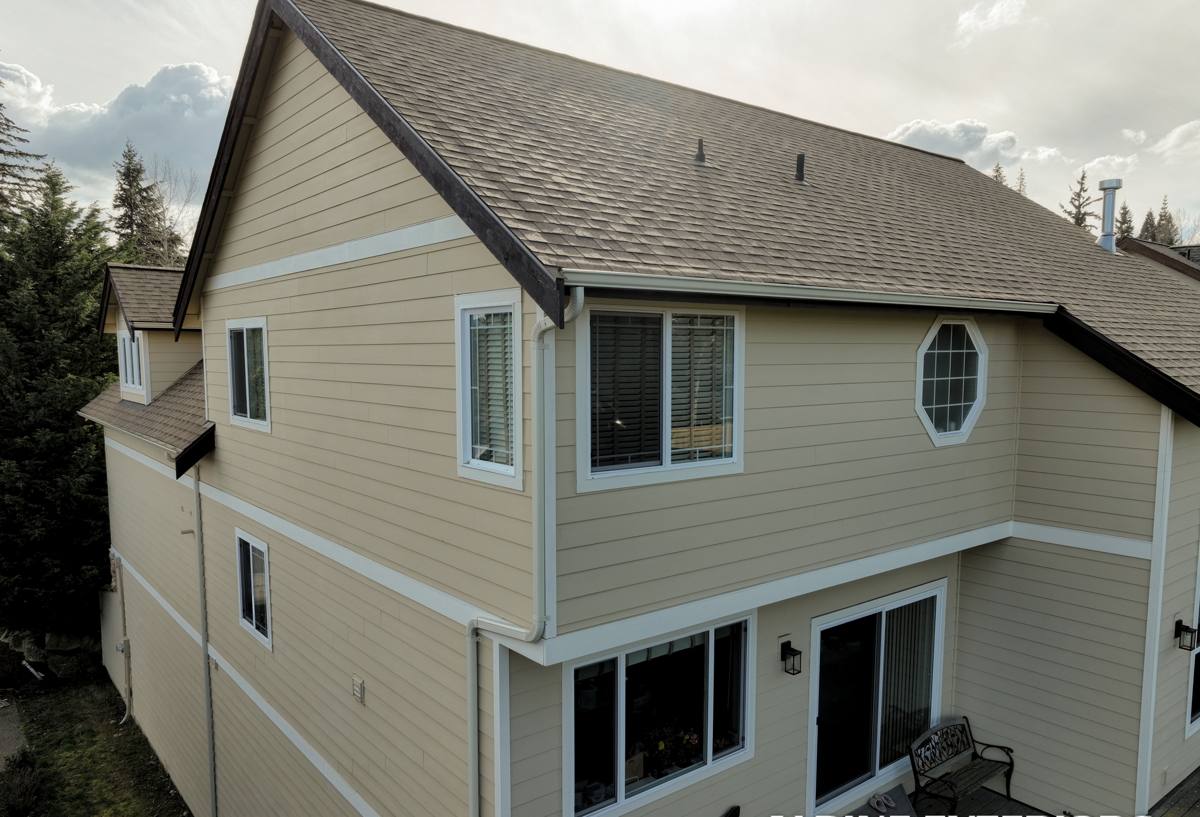
Roof replacement is also a natural moment to take stock of the rest of your home's exterior envelope, since scaffolding, ladders, and crews are already on site. Gutters, fascia boards, and the siding immediately below the roofline take a lot of the same wind-driven rain the roof does, and it's common to find rot or moisture damage at these transition points once the old roofing is off. If your siding is aging out at the same time — especially wood, LP, or older vinyl that's showing its own moisture problems — it's worth having both assessed together rather than treating the roof and the siding as unrelated projects. When siding replacement is on the table, we install James Hardie fiber cement specifically because it holds up to the same driving rain and marine air that wears down a roof, without the swelling, warping, or repainting cycles that plague wood and lower-grade composite products in this climate.
Getting Started
A roof replacement is a significant investment, and the right call depends on details specific to your home — its age, pitch, tree cover, and how it's held up so far. If you're seeing warning signs, or you just want an honest read on where your roof stands, we're glad to take a look and walk you through what we find. Use the form below to request a free, no-pressure estimate.