 Seattle
 Fiber Cement Siding in Kirkland: Built for What This Climate Actually Does to a Wall
Kirkland sits on the east shore of Lake Washington in King County, in a stretch of the Puget Sound region where marine weather shapes almost every exterior decision on a home. Homes here range from mid-century ramblers to newer construction on tighter lots, but nearly all of them face the same three pressures: salt-tinged marine air drifting in off the Sound, driving rain that hits walls sideways instead of falling straight down, and a moss season that can run most of the year on shaded or north-facing exposures. Siding that looks fine walking out of a showroom can start showing real problems within a few wet seasons here if it wasn't chosen and installed with this climate in mind.
This page is specifically about fiber cement siding for Kirkland homes — what the climate demands of it, what a correct installation actually involves, and why we install James Hardie fiber cement exclusively rather than offering a menu of siding brands and materials.
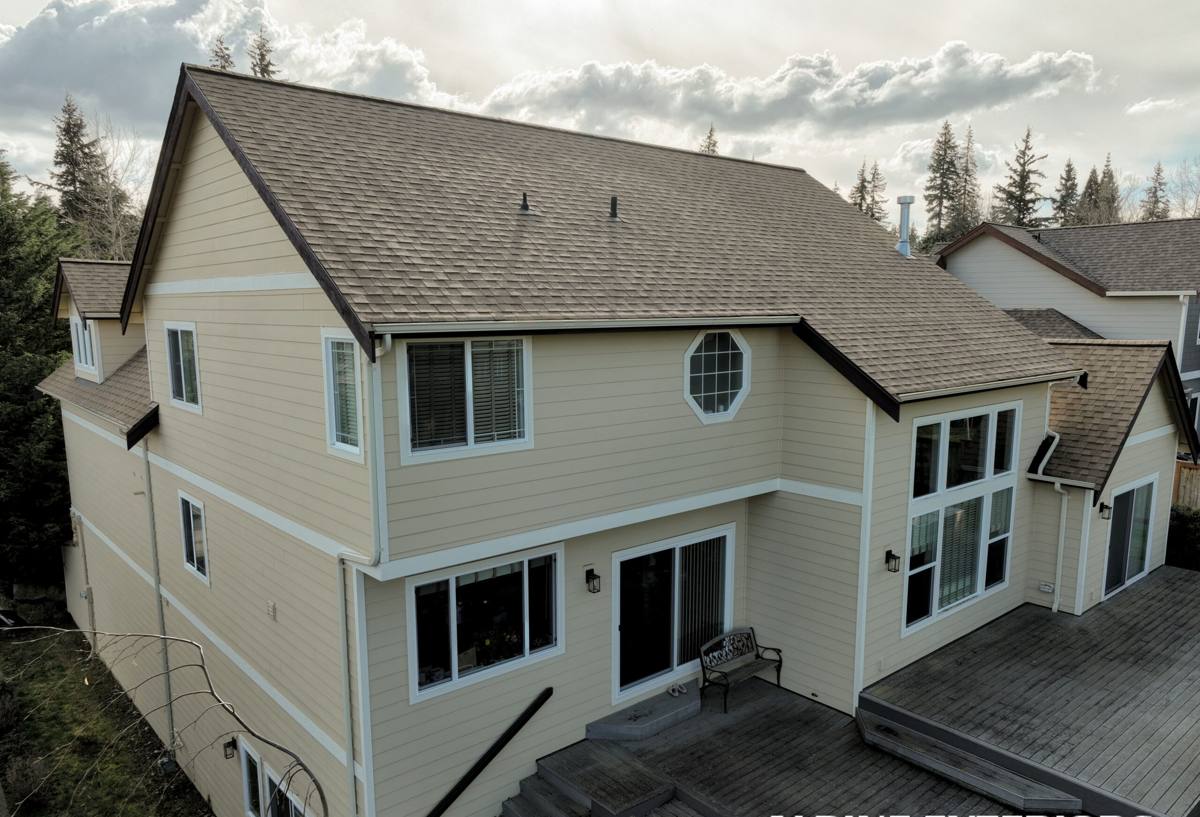
How Kirkland's Marine Climate Wears Down Siding
Driving Rain and Wind-Loaded Walls
Rain in this part of the Puget Sound lowlands rarely falls straight down for long. Wind pushes it sideways into lap joints, trim lines, and corners that a lot of siding systems were never really tested against, because most manufacturer specs assume rain moving mostly downward. Walls facing the prevailing weather — often west- and south-facing exposures — take a disproportionate share of this load and are usually the first place problems show up.
Marine Air and Metal Fatigue
Even set back from open water, homes throughout the Puget Sound area get a steady dose of salt-laden marine air. That air accelerates corrosion in fasteners, flashing, and trim hardware over time. A corroding fastener doesn't just look bad — it loses holding strength and can open a small gap at the point where it penetrates the siding, which becomes a direct entry point for water that only gets worse with time.
A Moss Season That Doesn't Really End
Mild temperatures and near-constant moisture give moss, algae, and mildew a long runway across most of the year, especially on shaded lots near mature trees, which describes a lot of Kirkland's older, established neighborhoods. Any siding material that's even slightly porous becomes a growth surface eventually. It typically shows up first on north-facing walls and areas shaded by trees or neighboring structures, well before it's visible from the street or driveway.
Why We Install Only James Hardie Fiber Cement
We used to offer more than one siding option. We stopped, and the reason was practical, not promotional: across enough tear-offs and service calls in this exact climate, one material consistently held up the way the rest didn't. James Hardie fiber cement is made from cement, sand, and cellulose fiber — a composition that's dimensionally stable and doesn't swell, cup, or delaminate at cut edges the way wood-based products do when they cycle wet and dry over and over.
We don't install vinyl, LP SmartSide, cedar, primed spruce, Cemplank, or Allura, and we're upfront about why. Vinyl isn't dimensionally stable across temperature swings and its seams and J-channels create points where wind-driven rain can collect. Engineered wood and solid wood products absorb moisture into their fiber structure, and that absorbed water has to go somewhere — usually into cupping, checking, or edge swelling over time, which is a harder problem in a climate that stays wet as much as this one does. Those aren't defects so much as trade-offs, and in a marine climate that tests every seam and joint as often as Kirkland's does, they're trade-offs we'd rather not build a roof-to-grade exterior around.
James Hardie's ColorPlus factory-applied finish matters here specifically because it's baked on and cured under controlled conditions rather than field-applied on a ladder in variable Pacific Northwest weather. Site-applied paint jobs are far more sensitive to humidity and temperature at the time of application, and in a region where a dry, mild painting window can be narrow, that consistency is a real advantage — not a marketing point.
James Hardie Product Lines for Kirkland Homes
James Hardie's fiber cement system covers several profiles, and which one fits a given home usually comes down to its architecture and the look the homeowner is after. We work through these options during the estimate rather than defaulting to one product for every house.
| Product | What It Is | Where It Fits Well in Kirkland |
|---|---|---|
| HardiePlank lap siding | Horizontal lap boards in several textures and exposure widths | Traditional and craftsman-style homes across most Kirkland neighborhoods |
| HardiePanel vertical siding | Large-format vertical panels, often used with battens | Modern builds and accent walls, including board-and-batten looks |
| HardieShingle siding | Individual or panelized shingle profiles | Craftsman and cottage-style homes wanting a shingle texture without wood's moisture behavior |
| HardieTrim boards | Fiber cement trim for corners, fascia, and window/door surrounds | Pairs with any of the above for a consistent, non-combustible trim package |
All of these are available in James Hardie's climate-engineered HZ product formulations. Washington falls within the range Hardie designs its Northern (HZ5) formulation for, which is built around freeze-thaw cycling and sustained moisture exposure rather than the heat and humidity profile its Southern formulation targets. That distinction matters less for curb appeal and more for how the board itself is engineered to behave over decades in this specific climate.
What a Correct Installation Involves
Water-Resistive Barrier and Flashing Sequencing
Before the first plank goes up, the wall needs a continuous, properly lapped water-resistive barrier and correctly sequenced flashing at every window, door, and penetration. Flashing installed out of order with the house wrap — even by a small margin — can direct water behind the barrier instead of out and away from it, and that mistake is invisible until it isn't.
Fastening, Clearances, and Cut-Edge Sealing
James Hardie specifies fastener type, spacing, and depth by product and application, and those specs exist for a reason — under- or over-driven fasteners both compromise performance. Cut edges need to be sealed per Hardie's instructions, and the siding needs proper clearance from grade, decks, and roof lines where water tends to collect and sit.
Rainscreen and Drainage Detailing
Hardie's installation instructions allow both direct-to-sheathing and drainage-gap applications depending on the product and situation. In a wet marine climate like this one, we lean toward drainage-gap detailing where it's appropriate, because it gives incidental moisture somewhere to go instead of sitting against the sheathing through a long wet season.
Our Process, Start to Finish
- On-site assessment of the existing siding, wall condition, and any problem areas specific to sun and wind exposure on that lot
- Full tear-off of the old siding — Hardie fiber cement isn't installed as an overlay, so the sheathing underneath gets inspected in the process
- Repair of any rot, damaged sheathing, or compromised framing found during tear-off, with clear communication before that work proceeds
- Installation of a continuous water-resistive barrier and correctly sequenced flashing at every opening and penetration
- Installation of James Hardie siding, trim, and accessories to manufacturer fastening, clearance, and sealing specifications
- Touch-up of cut edges and fastener heads using Hardie-matched products, since ColorPlus finishes need only spot touch-up rather than a full field-applied paint job
- Final walkthrough to confirm the finished work against what was scoped and priced at the estimate
What Affects the Cost of a Kirkland Fiber Cement Job
| Cost Factor | Why It Matters |
|---|---|
| Square footage and wall complexity | More corners, dormers, and roof lines mean more cuts, more flashing detail, and more labor time |
| Condition of the sheathing underneath | Rot or moisture damage found during tear-off has to be repaired before new siding goes on |
| Stories and site access | Multi-story homes and lots with limited access or steep grades take longer to stage and scaffold safely |
| Trim and color package | Custom ColorPlus colors, added trim boards, and accent details add material and labor beyond a basic lap-siding job |
| Mature landscaping | Established plantings and trees, common on older Kirkland lots, sometimes need protection or temporary clearing to work safely |
Why Hiring a Crew That Already Works Kirkland Matters
Kirkland sits under City of Kirkland permitting and inspection requirements, and a crew that already pulls permits and schedules inspections in this jurisdiction moves through that process with far fewer surprises than one learning it for the first time. Beyond paperwork, familiarity with the area means knowing which wall orientations on a given street tend to take the worst of the wind and rain, which neighborhoods have older sheathing more likely to need repair once the old siding comes off, and how to work around the mature trees and tighter lots common in a lot of Kirkland's established neighborhoods.
Local experience also shows up in smaller ways that add up: knowing which HOAs or design review processes apply in a given neighborhood, having a realistic sense of how weather windows work through a Puget Sound fall and winter for scheduling, and being able to point to work done nearby rather than asking a homeowner to take installation quality on faith.
Keeping Fiber Cement Siding Performing Long-Term
Correctly installed James Hardie siding is low-maintenance, but low-maintenance isn't the same as no-maintenance in a climate this wet. A short annual routine catches most problems while they're still small.
- Rinse siding periodically to keep organic growth from establishing on shaded or north-facing walls
- Check caulking at trim joints, window and door surrounds, and panel seams for cracking or separation
- Look at fastener heads and metal trim for early signs of corrosion, especially on walls that face prevailing wind and rain
- Keep gutters clear and downspouts directed away from the wall to limit water sheeting down the siding face
- Trim back vegetation that keeps a wall shaded and damp longer than the rest of the house
- Address any touch-up needs at cut edges or fastener heads promptly, using Hardie-matched paint rather than a mismatched general-purpose product
If you're planning a re-side, dealing with siding that's already showing its age, or just want a straight answer about what a correctly installed fiber cement wall should look like on your Kirkland home, we're glad to take a look. Reach out below for a free, no-pressure estimate.