 Seattle
 Redmond's Climate Is Harder on Siding Than It Looks
Redmond doesn't get the postcard version of Pacific Northwest weather. It gets the working version: eight-plus months a year of low clouds, drizzle that never quite becomes a real storm, and long stretches where a wall of siding might not see direct sun for days at a time. Add in how many Redmond lots back up to mature Douglas fir, cedar, and big-leaf maple cover, and you get the two conditions that do the most damage to a house's exterior — sustained moisture and shade. That combination is exactly what fuels the moss, algae, and mildew growth that shows up as green-black streaking on north-facing walls and anywhere siding sits close to landscaping or a fence line.
Because Redmond sits inland from the saltwater of Puget Sound, homes here are spared the direct salt-air corrosion that coastal King County properties deal with. What Redmond homes get instead is a steadier, quieter problem: near-constant humidity, driving rain that comes in at an angle during winter storms, and freeze-thaw cycles that, while mild compared to inland climates, still stress any siding material that has already absorbed water it shouldn't have. Over a decade or two, that steady moisture load is what separates siding systems that hold up from siding systems that start failing from the inside out.
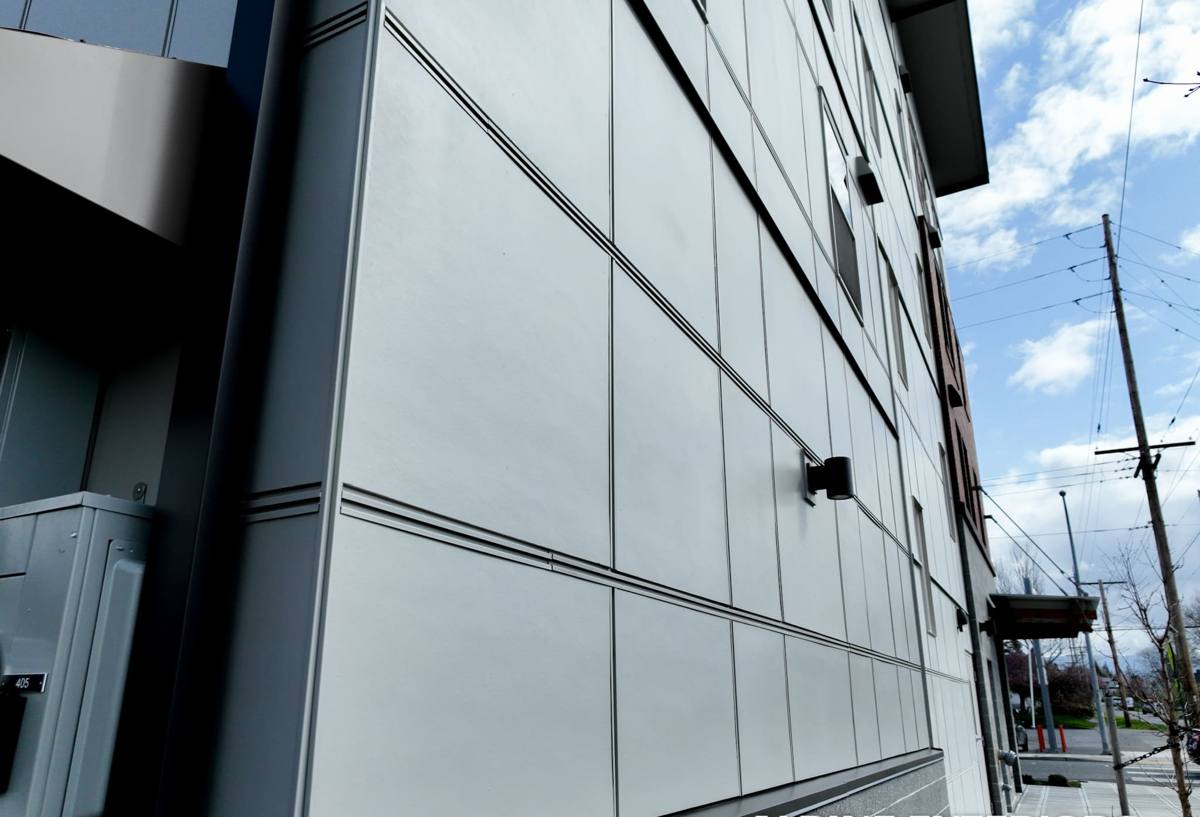
Why We Only Install James Hardie
We made a deliberate call to stop installing anything other than James Hardie fiber cement siding, and Redmond's climate is a big part of why. Wood-based and wood-adjacent siding products — primed spruce, cedar, and engineered wood siding like LP SmartSide — all share a vulnerability: their core material is organic, and organic material that stays damp for long periods is what moss, fungus, and rot feed on. In a climate as consistently wet and shaded as Redmond's, that vulnerability gets tested constantly, not occasionally.
James Hardie fiber cement is made from cement, sand, and cellulose fiber, and it's non-combustible and dimensionally stable in a way wood products can't match. It doesn't swell, warp, or provide the same food source for moss and mildew. It also holds paint and factory finish far longer than wood-based sidings, which matters in a climate where a home might go two or three years between good, dry stretches of weather long enough for a repaint to properly cure.
What We Don't Install, and Why
- Vinyl siding — lightweight and inexpensive, but it flexes, fades, and can crack in cold snaps; seams and panel movement create gaps where wind-driven rain works its way behind the cladding over time.
- Primed spruce and cedar — beautiful when new, but wood siding in a shaded, wet climate needs a maintenance schedule most homeowners can't realistically keep up with before rot sets in at joints and fastener points.
- LP SmartSide and similar engineered wood — better moisture resistance than raw wood, but the product still relies on an intact factory seal; any cut edge, fastener puncture, or caulk failure exposes the wood-strand core to the same moisture risk.
- Cemplank and Allura — competitor fiber cement products that are reasonable on paper, but we've standardized our crews, flashing details, and warranty process around one system so nothing gets installed off-spec.
None of these are "bad" products in every application. They're just not what we're willing to put our name on in a climate that punishes any weak point in a siding system for months at a time.
James Hardie's HZ Product Lines and Why Climate Zone Matters
James Hardie engineers its fiber cement products by climate zone (HZ), which is one of the more underappreciated details of the product line. A siding formulation designed for a hot, dry HZ10 climate isn't the same recipe as one designed for the wet, moderate-temperature HZ5 zone that covers King County and the rest of western Washington. HZ5 products are engineered with moisture resistance and freeze-thaw performance as the priority, not sun and heat resistance.
For Redmond homes, that means the lap siding, panel siding, or shingle-style siding going on the wall is formulated for exactly the conditions the house will face — not a generic national product. It's a detail that's easy to overlook when comparing siding bids, but it's a real difference in how the material performs over 20-plus years of Pacific Northwest weather.
What a Correct James Hardie Installation Actually Involves
Fiber cement siding is only as good as the installation behind it. James Hardie's own warranty is tied to installation following their published specifications, and in a climate like Redmond's, the details that get skipped on a rushed job are exactly the details that cause problems three, five, or ten years down the line.
The Details That Matter Most Here
- Weather-resistive barrier and flashing first. Before any siding goes up, the wall needs a properly lapped weather barrier and correctly integrated flashing at every window, door, and penetration — the single most common source of hidden moisture damage on any siding job.
- Proper clearance and gapping. Hardie siding needs a minimum gap from grade, roof lines, decks, and any hard surface, plus a small gap at butt joints to allow for expansion — skipping this traps moisture right where it does the most damage.
- Correct fastener pattern and depth. Nails or screws driven too deep, too shallow, or in the wrong location can crack the board or leave a path for water intrusion.
- Factory-primed cut edges get sealed. Every field cut exposes raw fiber cement; those edges need to be primed or sealed before installation, not left bare.
- Rainscreen or drainage gap where called for. In a climate this wet, a small air gap behind the siding lets any moisture that does get past the cladding drain and dry instead of sitting against the sheathing.
None of this is exotic work, but all of it takes time and discipline that a crew unfamiliar with fiber cement, or one pushing through a job too fast, tends to shortcut.
Signs a Redmond Home's Siding Needs Attention
Because moisture damage in this climate tends to develop slowly and quietly, most homeowners don't catch it until it's visible from the street. Some signs worth walking your own exterior to check for:
| What You See | What It Usually Means |
|---|---|
| Green or black streaking, especially on shaded or north-facing walls | Moss and algae growth from sustained moisture — cosmetic at first, but a sign the wall isn't drying between rains |
| Soft spots or visible swelling in wood or engineered wood siding | Moisture has reached the core material; this typically means replacement, not repair |
| Peeling or bubbling paint that returns soon after repainting | Moisture is trapped behind the finish, often from a failed vapor barrier or missing drainage gap |
| Cracked or warped boards near ground level or decks | Insufficient clearance from grade or hardscape allowing splash-back moisture and rot |
| Gaps or separation at seams and corners | Material movement from moisture cycling or original installation without expansion gaps |
Any one of these is worth a professional look before it spreads to the sheathing underneath, which turns a siding job into a structural repair.
Our Process for Redmond Siding Projects
Every project starts with an on-site walkthrough of the whole exterior, not just the section that looks obviously worn. Redmond homes on wooded or sloped lots often have shaded walls that are further along in moisture damage than the sun-exposed sides, and that context changes both the estimate and the plan.
- Assessment and measurement — full exterior walkthrough, checking for existing moisture damage, trim and flashing condition, and any drainage issues around the foundation or landscaping.
- Product and color selection — choosing the right Hardie board profile (lap, shingle, or panel) and ColorPlus factory finish for the home's style and HOA or neighborhood expectations where applicable.
- Removal and prep — stripping old siding down to the sheathing, checking for and repairing any rot or damage found underneath before anything new goes up.
- Weather barrier and flashing installation — the layer that does the real waterproofing work, installed and lapped correctly at every penetration.
- Hardie board installation — installed to James Hardie's published specifications for gapping, fastening, and sealed cut edges, maintaining warranty eligibility.
- Final trim, caulking, and cleanup — finish details completed and the site cleared of debris and old material.
What It Costs — and What Drives the Range
Every Redmond home is different, and an accurate number only comes from an on-site estimate, but the factors that move the price up or down are consistent across most jobs:
| Factor | How It Affects Cost |
|---|---|
| Home size and wall complexity | More square footage, dormers, and corners mean more material and labor |
| Existing siding removal | Tear-off adds labor; discovering rot underneath adds repair costs before new siding can go up |
| Board profile chosen | Shingle-style siding is more labor-intensive to install than standard lap siding |
| Trim and detail work | Homes with more windows, dormers, or architectural trim require more precise cutting and flashing |
| Access and lot conditions | Steep lots, tight side yards, or heavy landscaping around the home can slow staging and installation |
We'd rather walk a homeowner through these factors on-site than quote a number over the phone that doesn't hold up once the old siding comes off.
Maintaining James Hardie Siding in a Wet, Shaded Climate
One of the practical advantages of fiber cement in Redmond's climate is how little ongoing maintenance it actually needs compared to wood-based alternatives. That said, a few habits go a long way toward getting the full lifespan out of the investment:
- Rinse siding annually, especially shaded and north-facing walls, to keep moss and algae from establishing
- Trim back trees and shrubs so foliage isn't holding moisture against the siding surface
- Check and clear gutters before the fall rains start, since overflow is a common source of water running down the wall face
- Inspect caulking at trim, window, and door edges every couple of years and have any cracked sections resealed
- Address small paint chips or nicks promptly so bare fiber cement isn't left exposed to moisture
Why Hiring a Crew That Already Works Redmond Matters
Fiber cement installation is unforgiving of shortcuts, and the consequences of a bad install don't show up on day one — they show up in year three or five, after moisture has already gotten behind the cladding. A crew that regularly works Redmond and the surrounding Eastside communities knows the patterns specific to this area: which lot orientations tend to hold shade and moisture longest, how local permitting and inspection processes run, and what King County's climate zone means for product selection and installation detail. That local familiarity is the difference between a siding job that looks right on installation day and one that's actually built to hold up through another twenty Northwest winters.
If your Redmond home's siding is showing early signs of moisture damage, or you're planning ahead for a full replacement, we're happy to walk the exterior with you and give you a straight, no-pressure assessment. Use the form below to request a free estimate.