 Seattle
 Roof Repair Built for Kirkland's Wet, Mossy Climate
Kirkland sits right on Lake Washington, and that proximity to water shapes everything about how roofs age here. Between the lake-effect moisture, the long stretch of gray, drizzly months, and the shade cover from mature trees in many established neighborhoods, roofs in Kirkland take on a slower but steadier kind of punishment than roofs in drier parts of the country. It's rarely one big storm that causes the damage. It's months of dampness that never fully dries out, moss that gets a foothold in shaded valleys and north-facing slopes, and small entry points that go unnoticed until a ceiling stain shows up during the next round of driving rain.
We repair roofs for homeowners across Kirkland and the greater Seattle area, and we've learned that a repair here has to account for moisture retention, not just wind or impact damage like you'd see in other climates. That changes how we inspect, how we prioritize repairs, and how we talk to homeowners about what's actually wrong versus what can wait.
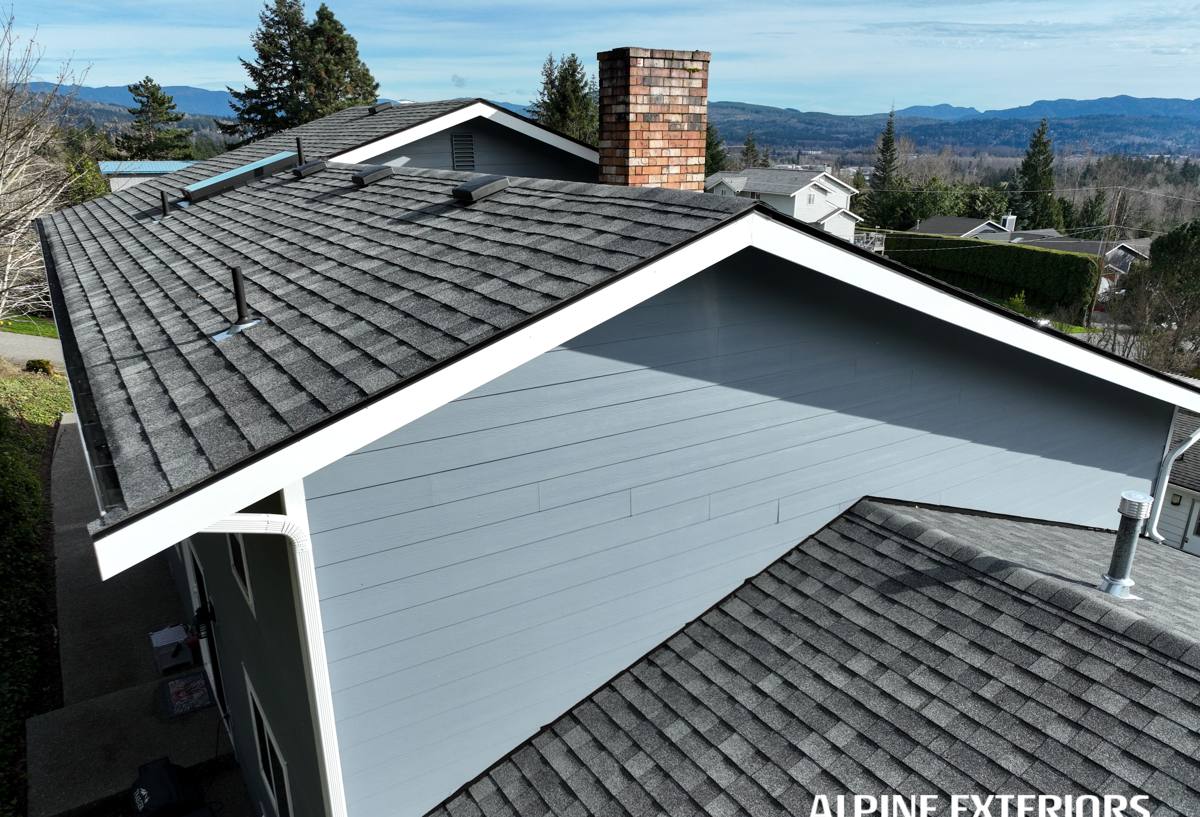
What King County's Climate Does to a Roof Over Time
Washington's marine climate means Kirkland roofs rarely deal with hail or extreme heat cycling, but they deal with something arguably harder to manage: sustained dampness. A few specific patterns show up again and again on local roofs.
Moss and Organic Growth
Moss thrives in shaded, moisture-retaining spots — typically the north-facing slope of a roof, areas under overhanging trees, and valleys where debris collects. Moss itself doesn't just sit on top of shingles; its root structure lifts shingle edges and holds water against the roof surface far longer than an open, sun-exposed area would. Left alone through a full moss season, that lifting action accelerates granule loss and opens the door to water intrusion at the shingle laps.
Driving Rain and Wind-Driven Moisture
Storms off the Sound and across Lake Washington often bring rain in at an angle rather than straight down. That matters because a roof designed to shed water vertically can still leak when rain is pushed sideways into flashing laps, exposed nail heads, or under shingle tabs that have started to curl. This is why flashing condition matters as much as the shingles themselves in this region.
Prolonged Dampness and Slow Rot
Because Kirkland rarely gets long dry stretches in fall through spring, once water finds its way under a roof covering, the decking underneath doesn't get much chance to dry out between rain events. Small leaks that would be a minor nuisance in a drier climate can quietly rot sheathing over one or two wet seasons.
Signs a Kirkland Roof Needs Repair, Not Just a Cleaning
Homeowners often call us after noticing moss and assume a wash and repel treatment will solve everything. Sometimes that's true. Other times the moss is a symptom of a deeper repair need. Here's how we help homeowners tell the difference.
- Dark streaking or moss concentrated on one slope, especially north-facing or shaded by trees
- Granules collecting in gutters or at the base of downspouts after rain
- Shingle edges that look lifted, curled, or cupped rather than lying flat
- Any interior ceiling stain, even a faint yellow-brown ring, after a heavy rain event
- Visible daylight or gaps around chimney flashing, vent boots, or skylight curbs
- Sagging or soft-feeling spots when walked (we check this carefully and safely)
- Missing, cracked, or displaced shingles after a windstorm
If you're seeing more than one of these, it's worth getting a real inspection rather than guessing. A roof that looks "mostly fine" from the ground can be hiding a small, fixable problem or a larger one — the only way to know is to get eyes on it.
How We Diagnose a Repair on a Kirkland Roof
We don't sell a repair off a driveway inspection or a photo. Our process is built around figuring out the actual cause of a problem, not just patching the symptom.
Step 1: Full Roof Walk and Moisture Check
We physically walk the roof where it's safe to do so, checking shingle condition, flashing integrity at every penetration, and moss or debris buildup slope by slope. Where we suspect water has already reached the decking, we check from the attic side for staining, darkened wood, or soft spots.
Step 2: Identify the Actual Entry Point
Water rarely shows up on the ceiling directly below where it entered the roof. It travels along rafters or sheathing before dripping. We trace the path back to the real source — often a flashing lap, a cracked pipe boot, or a section of moss-lifted shingles — rather than just resealing the spot where the stain appeared.
Step 3: Explain What We Found, in Plain Terms
We walk homeowners through what's actually happening, what's urgent versus what's cosmetic, and what a proper repair involves. We're not going to recommend a full re-roof if a targeted repair will genuinely solve the problem, and we're not going to patch something that needs a real fix just to keep the job small.
What a Correct Roof Repair Involves
A repair that holds up through a Kirkland winter needs more than a tube of sealant. Depending on what we find, a proper repair can include:
| Repair Type | What It Addresses | Why It Matters Locally |
|---|---|---|
| Shingle replacement (spot or section) | Cracked, curled, or missing shingles | Prevents moisture from reaching decking during sustained wet weather |
| Flashing repair or replacement | Leaks at chimneys, valleys, skylights, walls | Wind-driven rain exploits weak flashing more than open field areas |
| Moss treatment and removal | Organic growth lifting shingles | Kirkland's shaded, moist microclimates favor moss regrowth without upkeep |
| Decking repair | Rotted or soft sheathing under a leak point | Long wet seasons mean rot can spread before it's noticed |
| Ventilation correction | Trapped attic moisture and condensation | Poor ventilation compounds roof moisture problems from underneath |
| Gutter and edge repair | Water backing up under roof edges | Heavy rain volume needs a clear path off the roof, not just onto it |
Not every repair needs every line item above — a healthy roof with one damaged flashing detail might need nothing more than that single fix done correctly. The goal is matching the repair to the actual problem, not upselling unnecessary work.
Moss: Prevention Matters as Much as Removal
Because moss is such a persistent issue on shaded and north-facing roofs around Kirkland, removal alone is often a short-term fix. We talk to homeowners about the difference between a one-time moss removal and an approach that actually slows regrowth:
- Physical removal — carefully clearing moss without damaging granules or lifting shingles further
- Zinc or copper strips at the ridge, which release trace metal ions that inhibit moss regrowth over time as rain washes down the roof face
- Tree trimming coordination — reducing overhanging branches that keep a slope shaded and damp longer than the rest of the roof
- Debris clearing schedule — keeping valleys and gutters clear so organic material doesn't accumulate and hold moisture against the roof surface
None of this eliminates moss permanently in a climate like this one, but it meaningfully extends the time between treatments and reduces the chance moss causes real shingle damage before it's addressed.
Why It Matters to Hire a Crew That Already Works in Kirkland
Roofing crews that mostly work in drier climates sometimes underestimate how much moisture-driven damage differs from wind or impact damage. A contractor who works Kirkland and the broader King County area regularly sees how local roofs actually fail — where moss tends to establish itself first, which flashing details give out earliest under sustained wet-season exposure, and how attic ventilation problems show up differently on lake-adjacent homes versus more exposed properties farther from the water.
That familiarity shows up in smaller ways too — knowing what permitting or inspection expectations apply in the area, understanding how tree cover common in established Kirkland neighborhoods affects roof drainage, and being realistic about repair timing around the region's wettest months rather than promising work that weather won't actually allow.
What to Expect From Our Repair Process
We keep the process straightforward from first call to finished repair:
- Initial conversation about what you're noticing — stains, moss, missing shingles, or just wanting a checkup
- On-site inspection, including attic access where relevant, to find the actual cause
- Clear explanation of findings and a written scope of what repair work is needed and why
- Repair work completed with attention to matching existing materials where possible
- Final walkthrough so you understand what was done and what, if anything, to watch going forward
We're not interested in scaring homeowners into bigger jobs than they need, and we're not interested in doing a patch job that fails again next wet season. Both approaches cost homeowners more in the long run.
Timing a Repair Around Kirkland's Wet Season
Roof repairs can be done throughout the year, but timing affects how smoothly the work goes. Dry-weather windows make for cleaner shingle and flashing work, while damage discovered mid-winter often needs a more immediate, weather-permitting response to stop active leaking before a full repair can be scheduled. If you notice a problem during the wettest months, it's still worth getting an inspection promptly — a temporary measure to stop water intrusion is far better than waiting out the season with an active leak.
If you're dealing with moss buildup, a stubborn leak, or just want an honest read on your roof's condition before the next stretch of driving rain, we're happy to take a look. Reach out for a free, no-pressure estimate using the form below — we'll walk the roof, tell you what we find, and give you a straightforward plan for fixing it.