 Seattle
 Why Renton Siding Has to Work Harder Than the Brochure Suggests
Renton sits in a stretch of King County where weather rarely commits to one extreme — it just grinds. Homes here take on driving rain that comes sideways off gusts moving through the lowlands, a long stretch of overcast, damp months where moss and mildew get a head start on anything that holds moisture, and a marine-influenced air that carries salt and humidity even for houses well inland from open water. None of that is dramatic on any single day. It's the accumulation, year after year, that separates siding systems that hold up from ones that quietly fail behind a coat of paint.
That's the lens we use on every Renton siding job: not "does this look good going up," but "what does this wall assembly do in year eight, in year fifteen, after a hundred more soaking winters." Fiber cement done right is one of the few claddings that holds that line. Fiber cement done wrong — wrong flashing details, wrong caulking, wrong product for the exposure — fails in exactly the ways this climate is built to exploit.
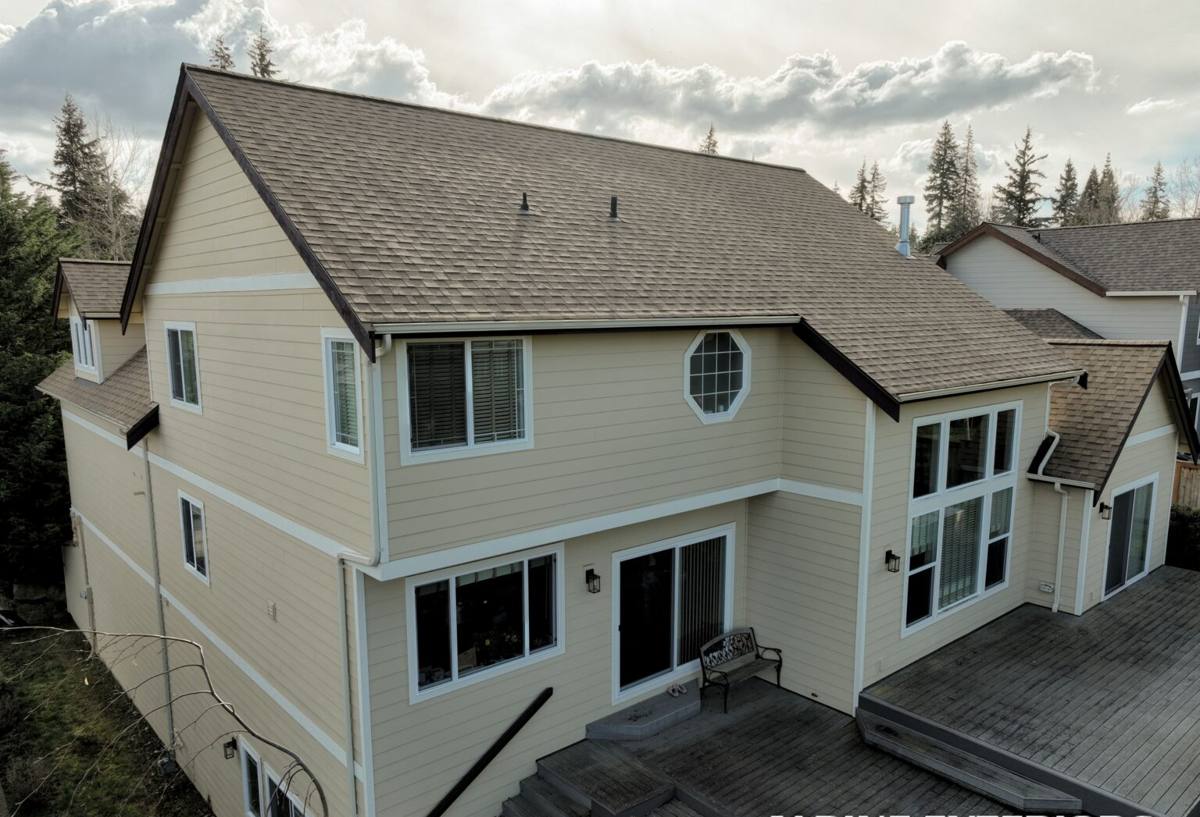
What Renton's Climate Actually Demands From a Siding System
Driving rain and wind-driven moisture
Wind off the Sound and through the valley doesn't just fall on a house — it pushes rain sideways into every horizontal joint, window head, and butt seam. A siding system needs a real drainage plane behind it, not just caulk at the surface, or that moisture finds its way into the sheathing.
The long moss and mildew season
King County's wet season stretches for months, and anything organic — moss, algae, mildew — gets a long runway to establish itself on north-facing walls, under eaves, and in any spot that stays shaded and damp. Siding material and finish both matter here: a factory-baked finish resists staining and biological growth far better than field-applied paint that starts breaking down the moment it's exposed.
Salt and marine air
Even homes set back from open water in this region deal with salt-laden air carried inland on weather systems. Over time that air is hard on fasteners, trim metals, and any siding material prone to swelling or corrosion-driven fastener failure. Fiber cement doesn't rot, swell, or feed rust the way some alternatives do, which matters more here than in a dry inland climate.
What a Correct Fiber Cement Installation Actually Involves
Fiber cement is only as good as the assembly it's installed into. The board itself is durable; the failures we get called out to fix almost always trace back to installation shortcuts, not the material.
- A drainage/rain-screen gap behind the siding so incidental moisture can escape instead of sitting against the sheathing
- Correct, weather-resistant barrier installed shingle-style so water is always shed downward and outward
- Metal flashing — not just caulk — over every window, door, and horizontal trim transition
- Proper fastener placement and type, sized and spaced to manufacturer spec, not "close enough"
- Correct minimum clearance from grade, decks, and roof lines so siding never sits in standing water or snow-melt runoff
- Factory-cut and sealed board ends, with field cuts back-primed or sealed before they go up
- Joints and butt seams caulked with a product rated for the exposure, not general-purpose sealant
Skip any one of these and the siding will still look fine at handoff. The problems show up two, five, ten years later — trapped moisture, swollen trim, staining at seams — long after the crew that cut corners is gone.
Why We Install Only James Hardie
We don't install LP SmartSide, vinyl, Cemplank, Allura, primed spruce, or cedar. That's a deliberate standard, not a sales pitch. Vinyl flexes, fades, and can't take the impact and heat cycling that this climate and this region's building patterns put on a wall. Wood siding needs a maintenance commitment most homeowners don't want to keep up in a climate this wet. Other fiber cement brands aren't necessarily bad products, but we've standardized our crews, our flashing details, our fastener schedules, and our warranty conversations around one system so there's no guesswork on site.
James Hardie's ColorPlus factory finish is baked on, not brushed on — it resists the fading, chalking, and moss staining that field-painted siding struggles with here. The HZ5 product line is engineered specifically for climates like ours, with moisture and freeze-thaw performance built into the formulation rather than bolted on afterward. It's non-combustible, it doesn't rot or delaminate, and it carries a strong transferable warranty when installed to spec — which is exactly why installation quality is the other half of this conversation.
Our Process for a Renton Siding Job
1. Walk and assessment
We look at the whole exterior envelope, not just the siding — trim, flashing, window details, roofline transitions, and any signs of past moisture intrusion. Renton's mix of home ages means we regularly find older flashing details that were fine when installed but don't meet current best practice.
2. Tear-off and sheathing check
Once the old siding is off, we inspect the sheathing underneath. This is the point where hidden rot or moisture damage gets caught and addressed before it's sealed behind new siding for another twenty years.
3. Weather barrier and flashing
New house wrap or weather-resistant barrier goes on shingle-style, with flashing integrated at every penetration and horizontal transition — the step that does the most long-term work against King County's driving rain.
4. Hardie installation
Boards, panels, or trim go up to manufacturer spec: correct fastener schedule, correct clearances, correct caulking at joints designed to move with the building.
5. Finish and walkthrough
Trim, caulking, and touch-up finish out the job, followed by a walkthrough so you know exactly what was done and what to expect from the material going forward.
Choosing the Right Hardie Product for Your Renton Home
Not every home needs the same siding profile. The table below covers the main options we install and where they typically make sense.
| Product | Best For | Notes for This Climate |
|---|---|---|
| HardiePlank lap siding | Most single-family homes, traditional and modern styles | Most common choice; wide range of widths and textures, strong track record in wet climates |
| HardiePanel vertical siding | Modern facades, accent walls, gable ends | Fewer horizontal seams for water to find, popular on contemporary Renton builds |
| HardieShingle | Craftsman and cottage-style homes | Textured look without the maintenance burden of real wood shingle |
| HardieTrim | Corners, window and door surrounds, fascia | Pairs with any of the above; keeps trim details consistent and moisture-resistant |
What Siding Actually Costs to Do Right
Every Renton home is a different combination of square footage, wall complexity, and existing condition, so we won't quote a number without seeing the house. But it's worth understanding what actually drives the cost, so you can evaluate any estimate — ours or anyone else's — with clear eyes.
| Cost Factor | Why It Matters |
|---|---|
| Tear-off scope | Removing old siding down to sheathing costs more than installing over a clean, sound wall, but it's the only way to catch hidden damage |
| Sheathing repair | Rot or moisture damage found during tear-off adds cost but is far cheaper to fix now than after new siding seals it in |
| Wall complexity | Dormers, multiple gables, and lots of trim transitions take more labor and more flashing detail than a simple rectangular wall |
| Product selection | Plank, panel, and shingle profiles carry different material and labor costs; trim and accent choices add up |
| Story height and access | Two- and three-story walls, steep grades, and tight lot lines all affect labor time and equipment needs |
Living With Fiber Cement Siding in Renton
One of the real advantages of a correctly installed Hardie system in this climate is how little it asks of you afterward. It won't rot, it won't need repainting on the schedule wood does, and the factory finish holds up against the region's moss and mildew far better than field-applied paint. That said, a wet climate is still a wet climate:
- Rinse siding periodically to keep moss and algae from establishing, especially on shaded north-facing walls
- Keep gutters clear so overflow doesn't run down the siding face or pool at the base of walls
- Trim back landscaping that holds moisture against the siding or blocks it from drying between rain events
- Have caulking and trim joints checked every few years — sealant is the one component that ages faster than the board itself
- Address any small trim or flashing issue right away; small gaps are cheap to fix and expensive to ignore
Signs Your Renton Home's Current Siding Is Losing the Fight
Some warning signs are obvious; others hide until you know what to look for.
- Soft or spongy spots when you press on the siding, especially near the bottom courses
- Persistent moss, algae, or dark staining that comes back within weeks of cleaning
- Paint that's peeling, bubbling, or needing repainting more often than every five to seven years
- Visible gaps or separation at seams, corners, or trim boards
- Warping, swelling, or cupping boards, particularly on sun- and rain-exposed walls
- Rising energy bills that track with drafts you can feel near exterior walls
Any one of these on its own isn't necessarily an emergency. Several at once, or any sign of soft sheathing underneath, means it's time for a real assessment before the damage spreads.
Why It Matters That We Already Work Renton
A crew that installs siding across a wide, varied region learns generic best practices. A crew that works Renton and the surrounding King County communities regularly learns the specifics: which wall orientations take the worst of the driving rain, where moss establishes fastest, which older home styles in the area tend to have flashing details that need extra attention during tear-off, and what local permitting and inspection expectations actually look like. That familiarity shows up in fewer surprises during the job and a finished install that's built for exactly the conditions your house will face, not a national-average version of them.
If your Renton home's siding is aging out, showing early wear, or you're planning ahead rather than reacting to a problem, we're happy to take a look and give you a straight, no-pressure assessment of what it needs. Reach out for a free estimate using the form below.