 Seattle
 What Renton's Climate Does to Siding Over Time
Renton sits in the same marine weather pattern as the rest of the Puget Sound basin: long wet winters, driving rain that comes in sideways off the water more often than straight down, and a shoulder season where things stay damp for weeks without ever fully drying out. Add the tree cover common in Renton's older neighborhoods and the shaded north- and east-facing walls typical of homes built close together, and you get a long moss and algae season that runs from fall through spring. Salt-laden air off Puget Sound reaches inland with the marine wind pattern too, which speeds up corrosion on fasteners, flashing, and any exposed metal trim.
None of that is exotic — it's just the Pacific Northwest doing what it does. But it's hard on siding that wasn't built for sustained moisture exposure. Wood siding absorbs water at end grain and seams, then swells and checks as it dries. Vinyl doesn't rot, but it doesn't stop water either — it relies entirely on the house wrap and flashing behind it, and it becomes brittle and prone to cracking in cold snaps. Engineered wood products can perform well for years and then fail quickly once moisture finds a way past the coating, usually at a poorly sealed cut edge or fastener. Renton homeowners who've owned their house through a few PNW winters have usually already seen one of these failure modes, even if they didn't know what caused it.
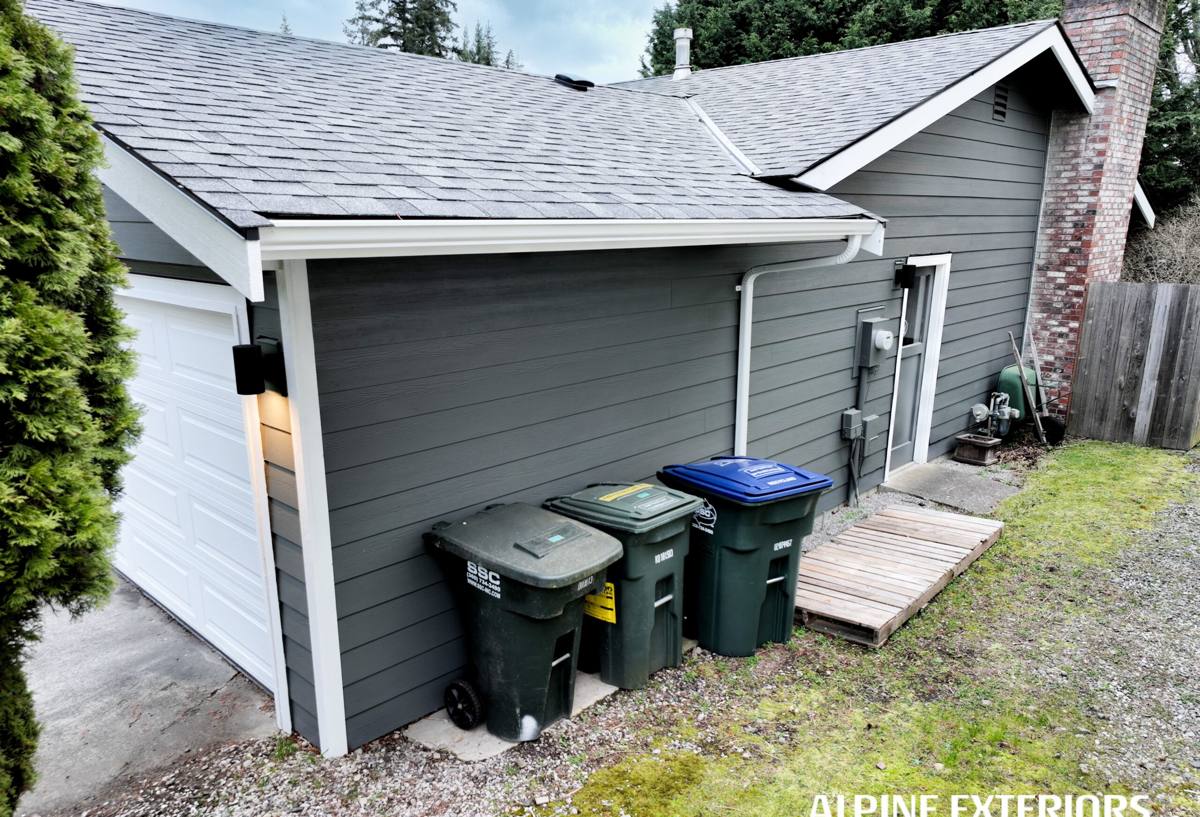
Signs a Renton Home Needs Replacement, Not Another Repair
Not every siding problem calls for a full tear-off. But there's a point where patching stops making sense and replacement becomes the more honest recommendation. Watch for:
- Soft or spongy spots when you press on the siding, especially near the bottom courses and around window trim
- Paint that won't hold — blistering, peeling, or needing repainting every 2-3 years instead of every 7-10
- Persistent moss or black streaking that comes right back within a season of cleaning
- Visible gaps, warping, or buckling panels, particularly on the sides of the house that face prevailing wind and rain
- Cracking or splitting at butt joints and corners, where water intrusion usually starts
- Musty smell or soft drywall on interior walls that back up to exterior siding — a sign moisture has already gotten past the cladding
If you're seeing two or more of these on the same wall, the underlying weather-resistive barrier has likely already been compromised in that area, and spot repairs won't address it.
What a Correct Siding Replacement Actually Involves
Siding replacement isn't just swapping old boards for new ones. The siding itself is the least important part of keeping water out of a wall — the systems behind it do the real work. A correct job on a Renton home includes:
Tear-off and inspection
Removing the old siding down to the sheathing lets us actually see the wall instead of guessing. This is where rot, damaged sheathing, or a failed weather barrier gets caught before it's covered up again for another 20 years.
Weather-resistive barrier
A new, continuous water-resistive barrier goes over the sheathing, lapped correctly from bottom to top so water sheds downward and out, never inward. This layer matters more than the siding brand on top of it.
Flashing at every penetration
Windows, doors, hose bibs, vents, and any other wall penetration need proper flashing integrated with the weather barrier — not caulk used as a substitute for flashing. This is the single most common shortcut on rushed siding jobs, and it's usually invisible until a wall starts failing from the inside.
Rainscreen or drainage gap
Given how much moisture the Puget Sound climate throws at a wall, a drainage gap behind the siding gives incidental water a path to escape instead of sitting against the cladding. This is standard practice on the installations we do.
Correct fastening and clearances
Manufacturer-specified fastener patterns, proper clearance from grade, roofing, and decks, and correct joint treatment all affect how the siding performs over the next 30-50 years, not just how it looks the day it's installed.
Why We Install Only James Hardie Fiber Cement
We standardized on James Hardie fiber cement siding and don't install vinyl, LP SmartSide, Cemplank, Allura, or bare wood siding. That's not a marketing position — it's a decision based on what holds up under repeated exposure to the kind of weather Renton gets.
| Factor | James Hardie Fiber Cement | Vinyl / Engineered Wood |
|---|---|---|
| Moisture behavior | Non-combustible cement composite, engineered to resist moisture-related warping and rot | Vinyl doesn't absorb water but relies fully on flashing; engineered wood can swell or fail if the coating is breached |
| Finish | Factory-applied ColorPlus finish, baked on, resists fading and chipping | Vinyl color is through-body but fades over time; site-painted wood needs repainting on a shorter cycle |
| Fire rating | Non-combustible, class A fire rating | Vinyl melts/deforms under heat; wood-based products are combustible |
| Moss and algae resistance | Dense cement surface resists moss anchoring better than porous or textured alternatives | Textured wood-composite surfaces can give moss and algae more to grip |
| Warranty | Long-term, transferable manufacturer warranty on the product | Varies widely by product and manufacturer |
Fiber cement isn't magic — it still has to be installed correctly, with the right flashing, gapping, and fastening, to earn that lifespan. But as a material, it gives a Renton home a real structural advantage against the specific climate stresses it faces: sustained damp, temperature swings, and a moss season that lasts most of the year.
James Hardie Product Lines We Work With
Hardie makes climate-engineered product lines, and for the Pacific Northwest that generally means their HZ5 formulation, built for wetter, colder regions rather than the HZ10 formulation sold in hot, dry climates. We'll walk through board profile options — lap siding, shingle-style panels, and trim — based on your home's style and what fits the neighborhood. The goal is always a system, not just a product: siding, trim, and flashing that work together.
Our Renton Siding Replacement Process
- Walkthrough and assessment — we look at your current siding, note problem areas, and check for signs of moisture already behind the wall
- Written estimate — scope, product selection, and pricing laid out before any work starts, no pressure to decide on the spot
- Tear-off and sheathing inspection — old siding comes off, sheathing gets checked and repaired where needed
- Weather barrier and flashing installation — the part that actually keeps water out, done to manufacturer spec
- Hardie siding installation — correct fastening, clearances, and joint treatment throughout
- Final walkthrough — we go over the finished work with you before calling the job done
What Affects Siding Replacement Cost in Renton
| Factor | How It Affects Cost |
|---|---|
| Home size and wall area | More square footage means more material and labor, the biggest single driver of price |
| Sheathing condition | Rotted or damaged sheathing found during tear-off adds repair work not visible in an estimate before the walls are opened |
| Number of stories and access | Two- and three-story walls, tight side yards, or steep grade change the equipment and labor needed |
| Trim and detail complexity | Homes with more corners, window trim, and architectural detail take more time than a simple rectangular footprint |
| Product selection | Board profile, texture, and prefinished color options affect material cost |
We don't quote a number until we've actually looked at the house — anything given sight-unseen is a guess, and guesses aren't useful to you when you're budgeting.
Why a Crew That Already Works Renton Makes a Difference
A contractor who works this area regularly already understands what King County permitting requires, has a working sense of how each neighborhood's homes were originally built, and isn't learning the region's weather patterns on your project. That familiarity shows up in small but real ways — knowing which wall orientations take the worst weather, sizing up drainage and grade issues around a foundation before they become siding problems, and not being surprised by the kind of moisture-related sheathing damage that's common once old siding comes off. It also means someone is genuinely local if you need a warranty question answered or a service call years down the road, not a crew that worked the area once and moved on.
Living With Hardie Siding Through Renton Winters
Fiber cement siding is low-maintenance, not no-maintenance. A yearly rinse to knock off moss and grime, prompt attention to any caulking that shrinks or pulls away at trim joints, and keeping gutters and downspouts clear so water isn't dumping directly onto a wall will keep a correctly installed Hardie system performing for decades. Because the ColorPlus finish is factory-baked rather than field-applied, you're not on a repainting schedule the way you would be with wood — that alone removes one of the biggest recurring costs of siding ownership in a climate this wet.
A Few Things to Ask Any Siding Contractor Before You Hire
- Will you inspect and repair sheathing if it's found damaged during tear-off, and how is that priced?
- What weather-resistive barrier and flashing details do you use, specifically?
- Do you install a rainscreen or drainage gap behind the siding?
- Is the manufacturer warranty registered in my name, and what does it actually cover?
- Can I see the written scope of work before I sign anything?
If a contractor can't answer those clearly, that's worth noting before you commit.
If your Renton home's siding is showing its age, we're happy to take a look and give you a straightforward, no-pressure estimate — no obligation, just an honest read on what your home actually needs.