 Seattle
 Beacon Hill's Climate Is Harder on Siding Than It Looks
Beacon Hill sits on one of Seattle's higher ridgelines, which means homes up there catch weather that lower, more sheltered neighborhoods don't see as directly. Wind-driven rain off the Sound hits exposed walls at an angle, working its way behind trim, into butt joints, and under anything that isn't sealed the way it should be. Add King County's long, wet fall-through-spring stretch and you get siding that's wet far more often than it's dry.
Then there's shade. Beacon Hill has plenty of mature tree cover in pockets across the neighborhood, and anywhere that canopy blocks direct sun, siding stays damp longer after every storm. That's exactly the condition moss, algae, and mildew need to take hold. Once a section of siding is chronically damp, paint fails faster, seams swell, and any hidden gap in the water-resistive barrier turns into a slow leak instead of a fast, obvious one.
None of this means Beacon Hill siding is doomed — it means repairs here have to account for moisture and exposure that a one-size-fits-all patch job usually ignores.
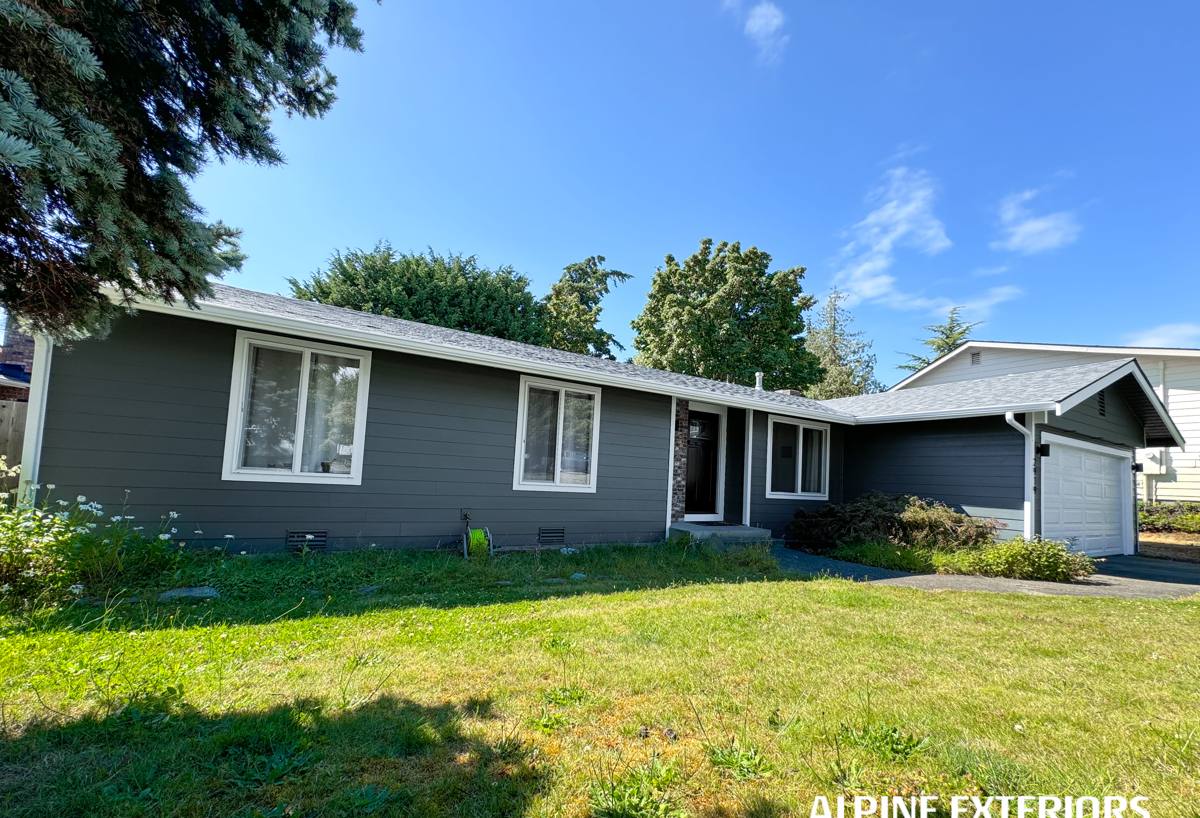
Signs Your Siding Needs Repair — Not a Full Replacement
Most siding problems we see on Beacon Hill homes are localized, not neighborhood-wide failures. Catching them early is what keeps a repair a repair instead of a replacement. Watch for:
- Soft or spongy spots when you press on a board, especially near the bottom courses or below windows
- Paint that's bubbling, peeling, or flaking in one area while the rest of the wall looks fine
- Dark streaking, moss, or algae concentrated under eaves, in shaded corners, or near downspouts
- Visible gaps, cracked caulk, or separation at butt joints, corner trim, and window and door casings
- Warping, cupping, or boards that look wavy from a distance
- Musty smell or discoloration on interior walls that share an exterior wall with a suspect area
Any one of these can usually be corrected with a targeted repair if it's caught before the underlying structure — the sheathing, framing, or water-resistive barrier — is compromised. Wait too long and a $400 repair becomes a $4,000 one.
What a Correct Siding Repair Actually Involves
It Starts With Finding the Real Source
Damaged siding is usually a symptom, not the problem itself. Before we touch a single board, we're looking for where water is actually getting in — a failed flashing detail, a caulk joint that dried out and cracked, a nail hole that was never sealed, or grading and gutters pushing water back toward the wall. Replacing the visible damage without fixing the entry point just buys you the same repair again in a couple of years.
Matching Material and Water Management
A repair has to match the existing siding profile, reveal, and finish closely enough that it doesn't stand out — and it has to restore proper water management, not just cover the hole. That means correct flashing above windows, doors, and any horizontal trim; house wrap or building paper that laps correctly (upper layers over lower ones, never the reverse); and fasteners placed and sealed the way the manufacturer specifies, not just wherever is convenient.
Common Failure Points on Beacon Hill Homes
Given the wind and rain exposure up on the ridge, we most often find trouble at the same handful of spots: unsealed butt joints between siding boards, trim-to-siding transitions where caulk has failed, the bottom course near grade where splash-back keeps wood or fiber cement wet, and areas below roof valleys or gutters that overflow during heavy storms. A thorough repair addresses the detail, not just the symptom at the surface.
Repair or Replace? How We Make the Call
| Situation | Repair Usually Makes Sense | Replacement Usually Makes Sense |
|---|---|---|
| Extent of damage | Isolated to one or two wall sections | Recurring damage across multiple elevations |
| Sheathing/framing | Solid, no rot found once opened up | Soft sheathing or framing found underneath |
| Age of siding | Under 15–20 years, otherwise sound | Original siding is at or past its expected service life |
| Material | Fiber cement or sound original material available to match | Discontinued profile, or existing product we don't stand behind long-term |
| Underlying cause | Single identifiable entry point (flashing, caulk, fastener) | Systemic water-resistive barrier failure |
We'll tell you plainly which category your home falls into. If a repair will hold up, we don't push a full re-side — that's not how we want to be known in this neighborhood.
Why We Repair — and Replace — With James Hardie Fiber Cement
Our company installs only James Hardie fiber cement siding, and that standard applies to repairs as much as full projects. Hardie boards are engineered specifically for the wet Pacific Northwest climate King County sits in — HZ5 products are formulated for our freeze-thaw and moisture cycle, and the material itself is non-combustible and dimensionally stable, so it doesn't swell, cup, or rot the way wood-based products can when they take on repeated moisture.
That matters directly for repair work. When we open up a damaged section, we're often looking at what's underneath boards that were never rated for this much sustained dampness. Swapping in Hardie at the repair point gives you a section that will actually outperform the surrounding siding going forward, not just match it cosmetically. The factory-applied ColorPlus finish also means a repaired section can be color-matched precisely, rather than relying on field-mixed paint that weathers differently than the original.
We won't tell you Hardie is the only material that can ever work on a house — but it's the one we're willing to warranty and put our name behind, and after years of pulling apart failed siding across Seattle, it's what we choose for our own work.
Our Process for a Beacon Hill Siding Repair
- Inspection and diagnosis — We assess the visible damage and probe for soft spots, then identify the likely water entry point before quoting anything.
- Opening the affected area — We remove damaged siding and trim carefully to check sheathing, framing, and the water-resistive barrier underneath.
- Correcting the cause — Flashing, house wrap laps, caulk joints, and fastening are repaired to proper spec, not just patched over.
- Installing matched material — New James Hardie boards or trim are cut, fastened, and finished to match the surrounding siding as closely as possible.
- Final sealing and cleanup — Joints are sealed with a quality exterior-rated sealant, and the work area is cleaned before we walk it with you.
Why Local Experience on Beacon Hill Matters
A crew that only sees a neighborhood once has no memory of how it behaves in a storm. Working repeatedly across Seattle's neighborhoods means we've seen how exposure changes block to block — which elevations catch the worst of the wind-driven rain, which types of trim details fail first under a ridge's worth of weather, and which drainage and moss issues show up again and again in shadier, tree-covered lots. That pattern recognition shortens the diagnosis and helps us fix the actual cause the first time, instead of guessing.
It also means we're not disappearing after the invoice. A local crew has a reputation in the neighborhood to protect, and callbacks cost us more than getting it right the first time.
What Affects the Cost of a Siding Repair
| Factor | Why It Matters |
|---|---|
| Size and location of damage | Ground-level repairs are simpler than second-story or steep-access sections |
| Underlying rot or water damage | Sheathing or framing repair adds labor and material beyond the siding itself |
| Material match | Matching an older or discontinued profile can take more time than a straightforward swap |
| Number of failure points | One clean entry point costs less to correct than several scattered issues |
| Access and site conditions | Landscaping, slope, or tight setbacks common on hillside lots can affect labor time |
We give straightforward, itemized pricing after inspection — no inflated "while we're at it" upsells if a repair is genuinely all your home needs.
A Simple Maintenance Checklist for Beacon Hill Homeowners
- Walk your exterior twice a year, ideally before and after the wettest months, and look at every elevation, not just the front
- Check caulk at trim, window, and door joints for cracking or gaps and have it renewed before it fails completely
- Keep gutters clear so overflow isn't running down the wall face during heavy rain
- Trim back vegetation and branches that keep siding shaded and slow to dry
- Address moss or algae growth early — a gentle wash beats letting it hold moisture against the surface for months
- Investigate soft spots, bubbling paint, or interior staining right away instead of waiting for the next dry season
If you're seeing any of these signs on a Beacon Hill home, we're happy to take a look and give you an honest read on what's actually going on — no pressure, no inflated scope. Fill out the form below for a free estimate.