 Seattle
 Siding Repair Built for Bellevue's Weather, Not Just Its Curb Appeal
Bellevue homes take a steady beating from the same weather pattern that shapes the rest of King County: long stretches of driving rain from fall through spring, salt-tinged air drifting in off Puget Sound, and a moss season that can run eight months or more on shaded north- and east-facing walls. Siding here doesn't fail because of one bad storm. It fails slowly, from repeated cycles of saturation and drying, from moss holding moisture against a wall for months at a time, and from caulk and flashing details that were never quite right to begin with. A siding repair in this climate has to solve the actual cause of the damage, not just patch over the symptom.
We work on homes throughout Bellevue and the greater Seattle area, and the repair calls we get tend to follow a pattern: a soft spot near a downspout, bubbling paint under an eave, a section of siding that's visibly cupped or separating at the seams, or moss buildup that's finally been traced back to rot underneath. Whatever the entry point, our approach is the same — find where water is actually getting in, fix that, and then repair the siding itself with materials and methods that will hold up through the next twenty Northwest winters, not just the next inspection.
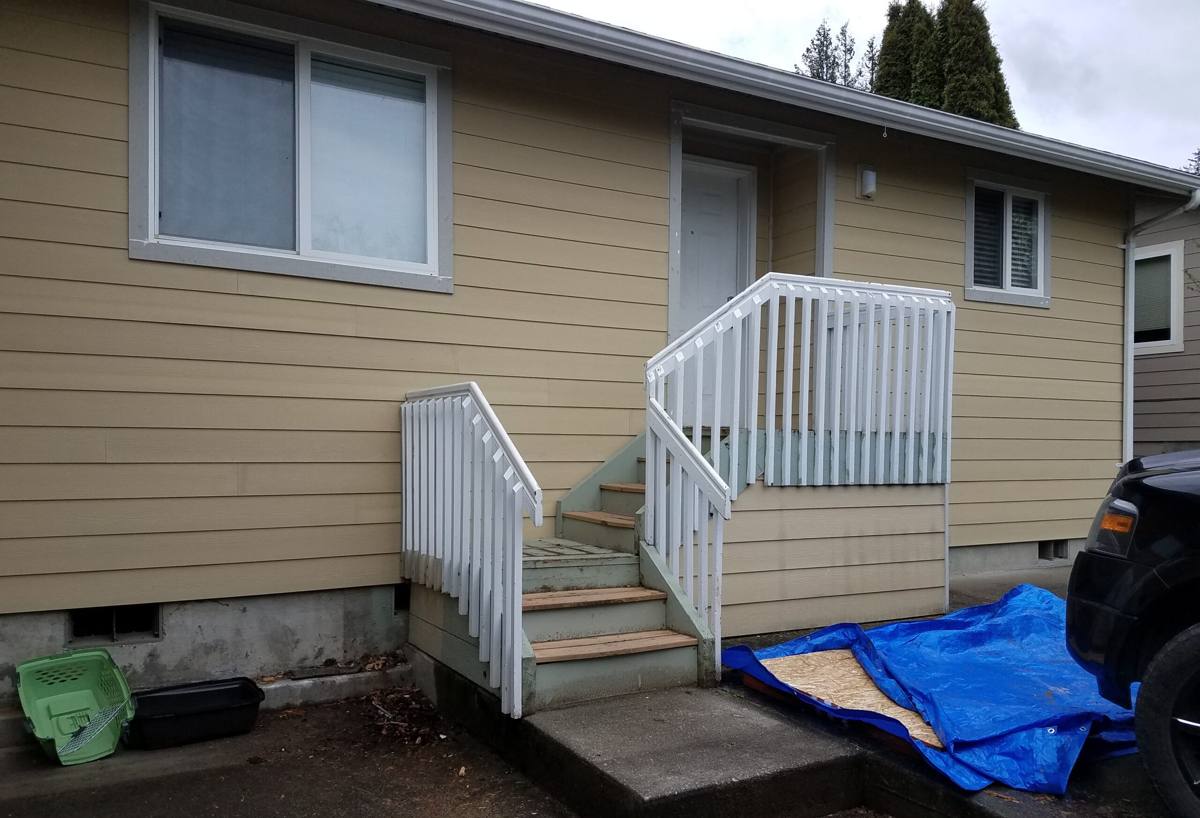
What Bellevue's Climate Does to Siding Over Time
Driving Rain and Wind-Driven Moisture
Bellevue sits close enough to Puget Sound and the Cascades' rain shadow edge that storms regularly come through with real horizontal force. Wind-driven rain doesn't just hit a wall — it works its way into any gap, lap seam, or fastener hole that isn't properly sealed or flashed. Over years, that's how water finds its way behind siding that looks fine from the ground.
Salt Air and Coastal Proximity
Homes closer to Lake Washington and the Sound deal with a mild but persistent salt-air exposure that accelerates corrosion on fasteners, flashing, and any exposed metal trim. Corroded fasteners loosen their grip on siding panels, which opens tiny gaps that let moisture in — a slow failure that's easy to miss until a panel is already loose or cracked.
Moss and Prolonged Shade
Bellevue's tree canopy and long wet season give moss everything it needs: shade, moisture, and time. Moss on a wall isn't just cosmetic. It holds water against the siding surface far longer than open air would, softens paint film, and on wood-based products it feeds rot directly. By the time moss is visibly thick, there's a good chance the material underneath has already started to soften.
Signs You Need Siding Repair, Not Just a Cleaning
- Soft, spongy, or crumbling spots when you press on the siding, especially near the bottom courses or under windows
- Visible cracking, cupping, or separation at panel seams
- Bubbling, peeling, or discolored paint that keeps coming back after repainting
- Persistent moss or algae growth that returns within a season of cleaning
- Staining or streaking below nail heads or seams, which usually means water is tracking through a gap
- Visible daylight or drafts felt from inside near exterior walls
- Warped or bowed sections, particularly around downspouts, hose bibs, or roof-wall intersections
Any one of these on its own might be minor. Several together, or any sign paired with soft material underneath, usually means water has been getting behind the siding for a while and the repair needs to address the water path, not just the surface damage.
What a Correct Siding Repair Actually Involves
A repair that only replaces the visible bad board and leaves the underlying cause alone tends to fail again within a year or two — often in the same spot. We treat every repair call as a small diagnostic job first.
1. Find the Water Path
Before removing anything, we look at where water is realistically getting behind the siding: failed caulking at trim joints, missing or corroded flashing above windows and doors, a downspout dumping water against a wall, or a grading issue directing runoff toward the foundation. Repairing siding without fixing the water source just delays the next repair call.
2. Inspect What's Behind the Siding
Once the damaged section is opened up, we check the house wrap or building paper, the sheathing, and any framing in the affected area. If moisture has reached the sheathing or framing, that has to be addressed — dried out, treated, or in some cases partially replaced — before new siding goes back on. Covering rot with new siding is one of the most common shortcuts that leads to bigger problems down the line.
3. Correct the Flashing and Water Management Details
Most siding failures we trace back to a flashing detail that was missing, undersized, or installed in the wrong sequence relative to the house wrap. We rebuild these details so water sheds outward and downward the way it's supposed to, rather than tracking behind the cladding.
4. Match and Install the Replacement Siding
For homes already sided in James Hardie fiber cement, we match the existing profile, exposure, and color as closely as the product line allows so the repair blends in rather than standing out as an obvious patch. Fasteners, seams, and caulking are installed to Hardie's published specifications, not general trade practice, since the two aren't always the same.
5. Final Check and Cleanup
We inspect the finished repair, clean up the work area, and walk the homeowner through what caused the original damage so it's clear what to watch for going forward.
Why We Only Repair With and Onto James Hardie Fiber Cement
We install exclusively James Hardie siding, and that standard carries into our repair work too. When a home is already sided in Hardie fiber cement, repairs are straightforward: the material is dimensionally stable, doesn't absorb water the way wood-based products do, and holds up under the same moss and moisture cycles that damage other materials, provided the original installation followed Hardie's specifications.
When we're called to repair a home sided in wood, primed spruce, vinyl, or other fiber cement products, we'll still diagnose and fix the immediate problem honestly. But we'll also tell you plainly if the underlying material is working against you — vinyl that's brittle and cracking from age and UV exposure, primed wood that's absorbed moisture at the seams, or a fiber cement product with a factory finish that hasn't held its color or seal as well as Hardie's ColorPlus finish. In those cases, a section-by-section repair sometimes reaches a point where a broader residing conversation makes more financial sense than continuing to chase individual failures.
Repair Approach by Existing Siding Material
| Existing Material | Typical Repair Challenge | Our Approach |
|---|---|---|
| James Hardie fiber cement | Isolated damage from a flashing or fastener failure | Match panel, exposure, and color; correct the water path; reinstall to spec |
| Primed wood or spruce | Moisture absorption and rot at seams and edges | Repair the affected sections; flag if moisture pattern suggests wider failure |
| Vinyl siding | Cracking, warping, or fading from age and UV/temperature swings | Replace damaged panels where matching stock exists; discuss residing if the whole run has degraded |
| Other fiber cement brands | Finish or coating wear at seams and cut edges | Repair and reseal exposed edges; note any pattern of coating failure |
Repair vs. Replacement: How We Help Bellevue Homeowners Decide
Not every damaged section needs a full residing project, and we're not going to tell you it does. A single soft board caused by one bad flashing detail is a repair. But if we're finding the same kind of damage in multiple spots around the house, or the siding material itself is past its practical service life, patch repairs start to cost more over a few years than a planned residing project would have.
We walk every repair site with that longer view in mind and give you a straight answer about which category your situation falls into, along with the reasoning behind it — not a sales pitch either direction.
Our Bellevue Siding Repair Process
- On-site inspection. We look at the damaged area, the surrounding siding, and the likely water source, including flashing, caulking, and grading nearby.
- Written scope and estimate. You get a clear explanation of what's causing the damage, what the repair involves, and an honest cost range before any work starts.
- Careful removal and inspection. Damaged siding comes off cleanly so we can check the sheathing and house wrap underneath.
- Correction of the root cause. Flashing, sealant, or drainage issues get fixed as part of the repair, not treated as optional extras.
- Repair and finish. New material is installed to manufacturer spec, matched as closely as possible to the surrounding siding.
- Walkthrough. We show you what was found and what was done, and flag anything worth keeping an eye on.
Why Hire a Crew That Already Works in Bellevue
Siding repair done wrong is expensive twice — once for the repair itself, and again a year or two later when the same spot fails again because the water source was never addressed. A crew that works Bellevue and the surrounding Seattle-area neighborhoods regularly knows the difference between damage caused by a one-time flashing mistake and damage caused by a material or design choice that's going to keep causing problems no matter how many times it's patched.
That local pattern recognition matters more here than in drier climates, because King County's rain volume and moss pressure punish shortcuts faster than most parts of the country. A repair crew that understands how water actually moves through a wall assembly in this weather — not just how to nail up a replacement board — is what keeps a repair from becoming a recurring expense.
Get a Straight Answer About Your Siding
If you're seeing soft spots, recurring moss, cracking, or paint that won't hold near Bellevue, we'll come take a look, explain what's actually causing it, and give you an honest repair recommendation — not an upsell. Request a free, no-pressure estimate using the form below and we'll get back to you with next steps.