 Seattle
 Building a Deck That Actually Holds Up in Bellevue
Bellevue sits close enough to Puget Sound and Lake Washington that homes here deal with a specific combination of weather stress: salt-tinged air moving off the water, long stretches of driving rain from fall through spring, and a moss season that can run half the year under mature tree canopy. A deck built with generic, one-size-fits-all methods will show it within a few seasons — soft spots at the ledger, black streaking on the boards, slippery moss on shaded stairs, and fasteners that bleed rust through the finish. A deck built for this specific climate looks and performs differently, and that difference shows up in the framing and flashing long before it shows up in the decking you actually walk on.
We build custom decks for homeowners throughout the Bellevue area as part of our regular Seattle-area service territory. This page covers what a correctly built deck needs here, what our process looks like from first call to final walkthrough, and what to actually look for when you're comparing contractors.
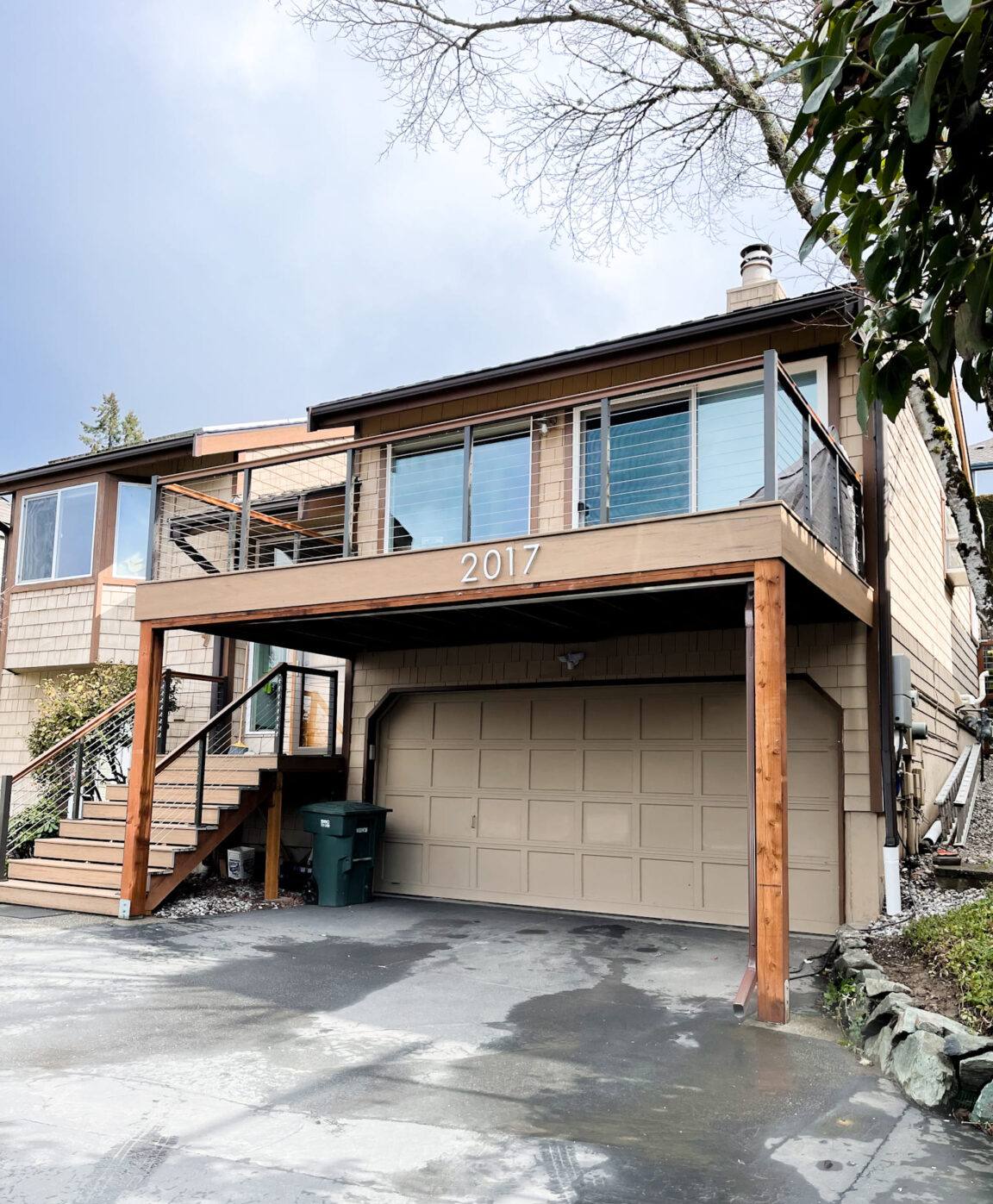
What "Custom" Actually Means for a Bellevue Deck
"Custom" gets used loosely in this trade, so it's worth being specific. For us it means the deck is designed around three things: your lot, your house, and how you actually plan to use the space — not a stock rectangle pulled off a plan sheet.
Lot and Grade
Many Bellevue lots have real slope, especially in the neighborhoods east of the lake where terrain rolls toward ravines and greenbelts. A custom design accounts for grade changes with proper post heights, stair runs that don't fight the yard, and footing depths that respect the actual soil conditions on your property rather than a generic assumption.
House Integration
The ledger board — where the deck attaches to the house — has to tie into your specific wall assembly, siding type, and weather barrier. This is the single most failure-prone connection on any deck, and it's also the one point where a rushed or generic install causes hidden rot behind the siding that you won't see until it's expensive.
Actual Use
A deck for entertaining needs different clearances, stair widths, and rail sightlines than a deck built mainly for a hot tub or a quiet morning-coffee spot. Custom design means we ask how you'll use it before we draw anything.
Choosing Decking Materials for Wet, Shaded Sites
This is usually the first decision homeowners want to make, and it's the one with the most long-term consequences. There's no universally "best" material — there's a best fit for your yard's sun exposure, your tolerance for maintenance, and your budget.
| Material | Moisture / Moss Behavior | Maintenance | Typical Lifespan |
|---|---|---|---|
| Pressure-treated wood | Absorbs water, needs sealing to resist moss and graying | Annual cleaning, sealing every 1-2 years | 15-20 years with upkeep |
| Cedar | Naturally rot-resistant but still needs sealing in shaded, wet spots | Cleaning and re-oiling every 1-2 years | 15-25 years with upkeep |
| Composite decking | Sheds water, resists rot; can still grow surface moss in deep shade without regular cleaning | Periodic washing, no sealing or staining | 25-30+ years, manufacturer-dependent |
| PVC decking | Fully water-resistant, best option for heavily shaded, low-airflow areas | Occasional washing | 25-30+ years, manufacturer-dependent |
Composite and PVC decking have become the default recommendation for shaded Bellevue lots simply because they don't absorb water the way wood does, which cuts down dramatically on moss growth and the black staining that comes with it. That said, we still build a fair number of wood decks — some homeowners want the look, the repairability, or the lower upfront cost, and there's nothing wrong with that choice as long as you go in knowing the maintenance commitment. Our job is to lay out the real trade-offs, not push a single product.
A Note on Fasteners and Hardware
Whatever decking material you choose, the hardware underneath matters just as much. In a marine-influenced climate, standard fasteners corrode faster than most homeowners expect. We spec stainless steel or coated fasteners rated for ground-contact and coastal exposure, and we use joist tape or flashing on top of framing members to keep water from wicking into the wood and rusting fasteners from the inside out. This is inexpensive relative to the total project cost and it's one of the most common corners cut on lower-bid decks.
Framing and Structure: The Part Nobody Sees
The decking boards get all the attention, but the framing underneath determines whether the deck is safe and how long it actually lasts. A few things we treat as non-negotiable:
- Footings sized and depth-set for the actual soil and frost conditions on your lot, not a minimum guess
- Proper joist spacing for your chosen decking material — composite and PVC often require tighter spacing than wood
- Structural ledger attachment with correct flashing, never just lag bolts into siding
- Post-to-beam and beam-to-joist connections using rated structural hardware, not toe-nailing
- Cross-bracing or diagonal bracing on taller structures for lateral stability
None of this is visible once the deck is finished, which is exactly why it's the part most likely to get shortcut by a crew focused on speed. It's also the part that determines whether your deck is still solid in fifteen years or needs structural repair in five.
Drainage, Ledger Flashing, and Moisture Control
Given the amount of rain King County sees, drainage design isn't optional — it's the backbone of a deck that lasts. Water needs a clear path off the deck surface, away from the house foundation, and away from the ledger connection.
Ledger Flashing
The ledger board attachment point is the single most common source of hidden rot in decks built in wet climates. We install proper Z-flashing and a moisture barrier behind the ledger so water sheds away from the house wall instead of tracking behind the siding. Skipping or under-doing this step is invisible at the time of construction and expensive to discover later.
Surface Drainage and Gapping
Board spacing has to allow water to drain through rather than pool on the surface. Under-deck drainage systems can be added where usable space below the deck matters, but even without one, correct board gapping and joist slope keep water moving instead of sitting.
Moss Prevention by Design
You can't design moss out entirely on a shaded, wet lot, but you can reduce it substantially: choosing a decking material that doesn't hold moisture, keeping airflow under the deck with proper skirting gaps, and avoiding low spots where water and debris collect. Regular cleaning still matters, but a well-designed deck needs far less of it.
Permits and Code in Bellevue and King County
Most custom decks above a certain height or size require a permit, and inspections typically cover footing depth, structural connections, guardrail height, and stair geometry. Requirements can vary depending on your specific jurisdiction within King County, and some Bellevue neighborhoods have additional HOA design guidelines on top of city code. We handle the permit process as part of our standard scope so you're not the one chasing down requirements or scheduling inspections.
Our Process, Start to Finish
- Free on-site estimate: We walk your property, look at grade, sun/shade exposure, and how the deck will connect to your house, and talk through what you actually want to use the space for.
- Design and material selection: You get a clear layout and an honest comparison of material options for your specific site conditions, with a real cost range for each.
- Permitting: We prepare and submit the permit package and handle inspection scheduling.
- Site prep and footings: Excavation and footings are set to the depth and spacing your soil and structure require.
- Framing: Ledger, posts, beams, and joists go in with rated hardware and full moisture protection at every connection.
- Decking, rail, and stairs: Your chosen material is installed with correct fastening and gapping.
- Final walkthrough: We go over the finished deck together and cover basic care specific to your material choice.
Keeping a New Deck Looking Good Through Seattle-Area Winters
Whatever material you choose, a little seasonal attention goes a long way in this climate.
- Sweep debris off the deck regularly in fall — wet leaves trap moisture against the surface and accelerate moss growth
- Rinse the deck surface periodically to remove airborne salt residue and organic buildup, especially in shaded areas
- Check stairs and shaded corners for moss buildup before it becomes a slip hazard
- Inspect the ledger flashing line yearly for any gaps or caulking failure
- For wood decks, plan on re-sealing every 1-2 years; for composite or PVC, an occasional wash is usually enough
- Keep gutters and downspouts near the deck clear so roof runoff isn't dumping extra water onto the structure
Why Hiring a Crew That Already Works Bellevue Matters
A contractor who works this area regularly already knows which framing details hold up against Puget Sound humidity, how local grading tends to run, and what King County inspectors look for at each stage. That familiarity translates into fewer surprises — fewer redesigns mid-project, fewer permit delays, and a finished deck that's actually built for the conditions it will sit in, not just for a dry-climate spec sheet. We're a Seattle-based crew that treats Bellevue as part of our regular service area, not a one-off job we had to research from scratch.
If you're planning a new deck or replacing one that's past its prime, we're happy to come take a look and talk through honest options for your yard. The estimate is free, there's no pressure, and you'll walk away with a clear sense of what the project actually involves — just fill out the form below to get started.