 Seattle
 Shoreline sits right where Puget Sound weather meets the kind of tree cover that keeps a roofline shaded most of the year. That combination is hard on a house. Salt-tinged air off the Sound, wind-driven rain that finds every gap in a wall system, and a moss season that can run eight months or longer all work on siding at the same time, year after year. If you're planning a siding project in Shoreline, it's worth understanding exactly what that environment does to different materials before you pick one.
We install James Hardie fiber cement siding exclusively, and we work in Shoreline neighborhoods regularly enough to know what tends to fail here and why. This page covers what Shoreline homes specifically need from their siding, what a correct fiber cement installation actually involves, and how our process works from first look to final walkthrough.
What Shoreline's Climate Actually Does to Siding
Shoreline isn't coastal in the dramatic sense, but it's close enough to Puget Sound that salt-laden air is a real factor, especially on west- and southwest-facing walls that catch prevailing wind. Salt air accelerates corrosion on fasteners, flashing, and any metal trim that isn't properly rated or protected. Over years, that shows up as staining, streaking, and eventually failure points where water gets behind the cladding.
Then there's the rain. King County doesn't just get a lot of precipitation — much of it arrives sideways during fall and winter storms, driven by wind off the Sound. Driving rain doesn't just wet a wall surface; it tests every seam, joint, and penetration in the siding system. A material or installation that handles vertical rain fine can still let water in when it's coming in at an angle for hours at a time.
Finally, moss and algae. Shoreline's tree canopy, cool temperatures, and long wet season create ideal conditions for organic growth on north-facing and shaded walls. Some siding materials resist this better than others, and the finish matters as much as the base material — a coating that holds up to UV in Arizona doesn't necessarily hold up to constant damp shade in the Pacific Northwest.
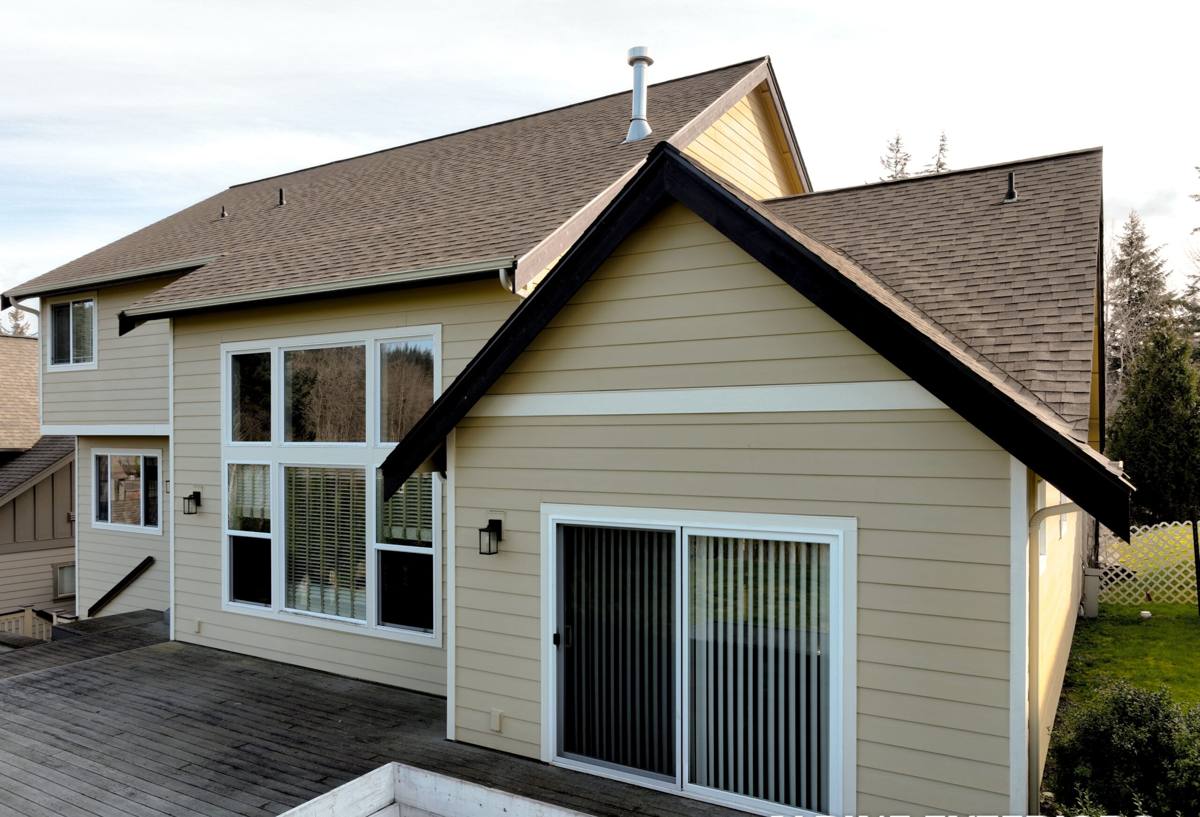
Why Fiber Cement Specifically Fits This Environment
Fiber cement is a mix of cellulose fiber, sand, and cement, engineered to be dimensionally stable — meaning it doesn't swell, shrink, or warp with moisture the way wood-based products can. That stability matters enormously in a climate where siding is wet more often than it's dry for half the year. A material that moves with moisture cycles opens up joints, cracks paint lines, and creates the small gaps where water eventually gets behind the cladding.
James Hardie also builds region-specific product lines. Their HZ5 formulation is engineered for climates with more moisture exposure and freeze-thaw cycling, which fits the Puget Sound region better than a generic national product. The factory-applied ColorPlus finish is baked on under controlled conditions and backed by its own finish warranty, which matters here specifically because field-applied paint has to cure and adhere correctly in a climate that doesn't always cooperate with paint schedules.
None of this means fiber cement is magic or maintenance-free. It means the material's core properties — non-combustible, moisture-stable, engineered for regional conditions — line up with what this specific climate demands, better than the alternatives we get asked about most.
What We See Go Wrong on Older Shoreline Homes
When we're called out to look at failing siding in this area, a handful of patterns show up repeatedly:
- Moss buildup at butt joints and behind trim where horizontal surfaces trap moisture and organic debris never fully dries out
- Corroded or undersized fasteners, especially on older installations that didn't account for salt air exposure on exposed walls
- Caulk failure at seams where the original installer relied on sealant instead of proper flashing and lap details to keep water out
- Paint failure on the north and west elevations, where shade and wind-driven rain combine to break down field-applied coatings faster than sunnier walls
- Soft or delaminating material at the bottom courses, usually from siding installed too close to grade, decking, or roof lines without the clearance it needs to shed water
Almost none of these are failures of "siding" as a category — they're failures of installation detail, product choice, or maintenance neglect meeting a climate that doesn't forgive shortcuts.
What a Correct Installation Involves
Fiber cement performs the way it's rated to perform only when it's installed to the manufacturer's specifications. In a climate like Shoreline's, a few details matter more than they would somewhere drier:
Water Management Behind the Siding
Every wall assembly we install includes a drainage plane — typically a weather-resistant barrier with a rainscreen gap — so that any moisture that does get past the siding has somewhere to go and can dry out rather than sitting against the sheathing. This is standard practice for us, not an upgrade, because in a climate with this much sustained rain, a wall system without a drainage path is a wall system that will eventually rot from the inside.
Flashing and Fastening
Every window, door, and roofline intersection gets properly integrated flashing before siding goes on, not caulk used as a substitute for it. Fasteners are corrosion-resistant and installed at manufacturer-specified spacing and depth — critical detail near the Sound, where standard fasteners corrode faster than inland installations.
Clearances and Joint Placement
Hardie specifies minimum clearances from grade, roofing, decks, and other horizontal surfaces for a reason: those are the spots where moisture lingers longest. We hold those clearances and stagger joints deliberately so seams aren't stacked in ways that concentrate water at a single point on the wall.
Caulking and Paint Lines
Factory-primed edges get sealed correctly at cuts, and ColorPlus finished boards are handled to preserve that factory coating rather than relying on field touch-up paint, which won't match the finish warranty or hold up the same way over time.
Our Process for a Shoreline Siding Project
| Step | What Happens |
|---|---|
| Site assessment | We walk the exterior, check current siding condition, look at drainage, grade clearance, and exposure on each elevation |
| Scope and estimate | We provide a written estimate covering material, prep, tear-off if needed, and installation detail — no surprise add-ons |
| Prep and moisture check | Old siding removed, sheathing inspected for hidden rot or moisture damage before anything new goes up |
| Weather barrier and rainscreen | Drainage plane installed correctly around every penetration, window, and door |
| Hardie installation | Siding installed to manufacturer spec — clearances, fastening, flashing, and joint staggering all held to code and warranty requirements |
| Trim, caulk, and finish detail | Trim and transitions sealed and finished to protect the factory coating and shed water at every seam |
| Final walkthrough | We review the completed work with you and go over any care and maintenance specifics for your home's exposure |
Cost Factors Specific to a Shoreline Project
Every home is different, but a few things tend to move the price on Shoreline jobs specifically:
| Factor | Why It Matters Here |
|---|---|
| Existing siding removal | Homes with moss-damaged or rotted original siding often need sheathing repair before new siding goes on |
| Access and lot layout | Mature trees and tighter lots common in Shoreline can add setup time and scaffolding needs |
| Exposure per elevation | West and southwest walls facing prevailing wind and salt air sometimes get upgraded flashing or fastener detail |
| Trim and architectural detail | Older Shoreline homes with more trim, gables, or dormers take more labor time to detail correctly |
| Product line and profile | Lap width, texture, and color selection within the Hardie lineup affect material cost |
We don't quote a job without seeing it. Broad regional pricing ranges you'll find online rarely account for what's actually happening on your walls, and giving you a number without an inspection isn't something we're willing to do.
Maintenance That Actually Matters in This Climate
Fiber cement reduces maintenance burden compared to wood-based sidings, but "reduced" isn't "none," especially with Shoreline's moss season. A short list of what actually keeps siding performing well here:
- Rinse siding annually, focusing on north-facing and shaded walls where moss and algae take hold first
- Keep gutters clear so overflow isn't running down and pooling behind siding at roof-to-wall intersections
- Trim back vegetation and tree limbs that keep walls shaded and damp longer than they need to be
- Inspect caulk lines at trim and penetrations every couple of years and have any cracking resealed before winter rains
- Watch for soft spots or discoloration near grade, decks, or where sprinklers hit the wall directly
Why Local Installation Experience Matters
Fiber cement is a forgiving material when it's installed correctly and an unforgiving one when it isn't. The details that matter in Shoreline — drainage planes, fastener corrosion resistance, clearance from grade, flashing at every penetration — aren't optional extras. They're the difference between siding that handles a Puget Sound winter for decades and siding that starts showing problems in five years.
A crew that's worked King County long enough to have seen what actually fails on local homes brings judgment to a job that a generic installation crew won't. That's not a sales pitch — it's the reason installation quality varies so much between contractors working with the exact same material.
Why We Only Install James Hardie
We don't install LP SmartSide, vinyl, Cemplank, Allura, or wood siding, and that's a deliberate standard, not an oversight. Each of those has real strengths in the right application. But for the maintenance burden, moisture behavior, and long-term performance we're willing to stand behind in a climate like this one, James Hardie's fiber cement — backed by a strong transferable warranty and a factory finish system built for exactly these conditions — is what we've standardized on. When we put our name on a job, we want the material underneath it to hold up the way we told the homeowner it would.
If you're weighing a siding project in Shoreline, we're happy to take a look at your home, walk you through what we're seeing, and put together a straightforward estimate — no pressure, no obligation. Reach out using the form below to get started.