 Seattle
 Ravenna sits inland from Puget Sound, but the weather doesn't treat it that way. Salt-tinged marine air still moves through this part of Seattle, King County's rain still comes in sideways during winter storms, and the mature tree canopy that gives the neighborhood its character also keeps a lot of walls shaded and damp for most of the year. Add in a housing stock that leans older — Craftsman bungalows, converted brick apartments, additions built onto homes that predate modern building standards — and you've got a neighborhood where siding choice and installation quality matter more than the sales brochures usually let on. We install James Hardie fiber cement exclusively, and this page is about what that actually means for a Ravenna home: what the climate demands, what a correct job looks like, and why the details matter as much as the product.
What Ravenna's Climate Does to a Sided Wall
None of the three factors below is dramatic by itself. Together, over ten or twenty years, they're a harder test on an exterior wall than a lot of siding products were built to handle.
Marine Air Reaches Inland Neighborhoods Too
It's easy to assume salt exposure is only a waterfront problem, but airborne salt moves with weather systems well beyond the shoreline, and Ravenna gets its share even though it's not sitting on the water. Salt-laden air accelerates the breakdown of weaker factory finishes and speeds up corrosion on fasteners and trim hardware. That kind of damage doesn't show up in year one — it shows up slowly, as fading, chalking, or rust bleed a decade in, which is exactly the kind of failure that's easy to miss until it's already expensive.
Wind-Driven Rain
Rain in this part of Seattle rarely falls straight down for long. Wind pushes it sideways into lap joints, under trim, and into any seam where the water management detail isn't right. That's a much tougher test for caulked joints and painted surfaces than a simple annual rainfall number would suggest, and it's a big part of why installation quality ends up mattering as much as the material itself.
A Long Moss Season Under the Tree Canopy
Ravenna's mature trees are one of the things people like about the neighborhood, and they're also the reason a lot of walls here stay shaded and slow to dry. Mild temperatures and steady moisture add up to active moss and mildew growth for most of the year on north-facing or tree-covered exposures. Organic growth on a siding surface holds moisture against the wall behind it, and that trapped-moisture cycle is where a lot of long-term siding problems actually start.
Why Ravenna's Older Homes Change the Job
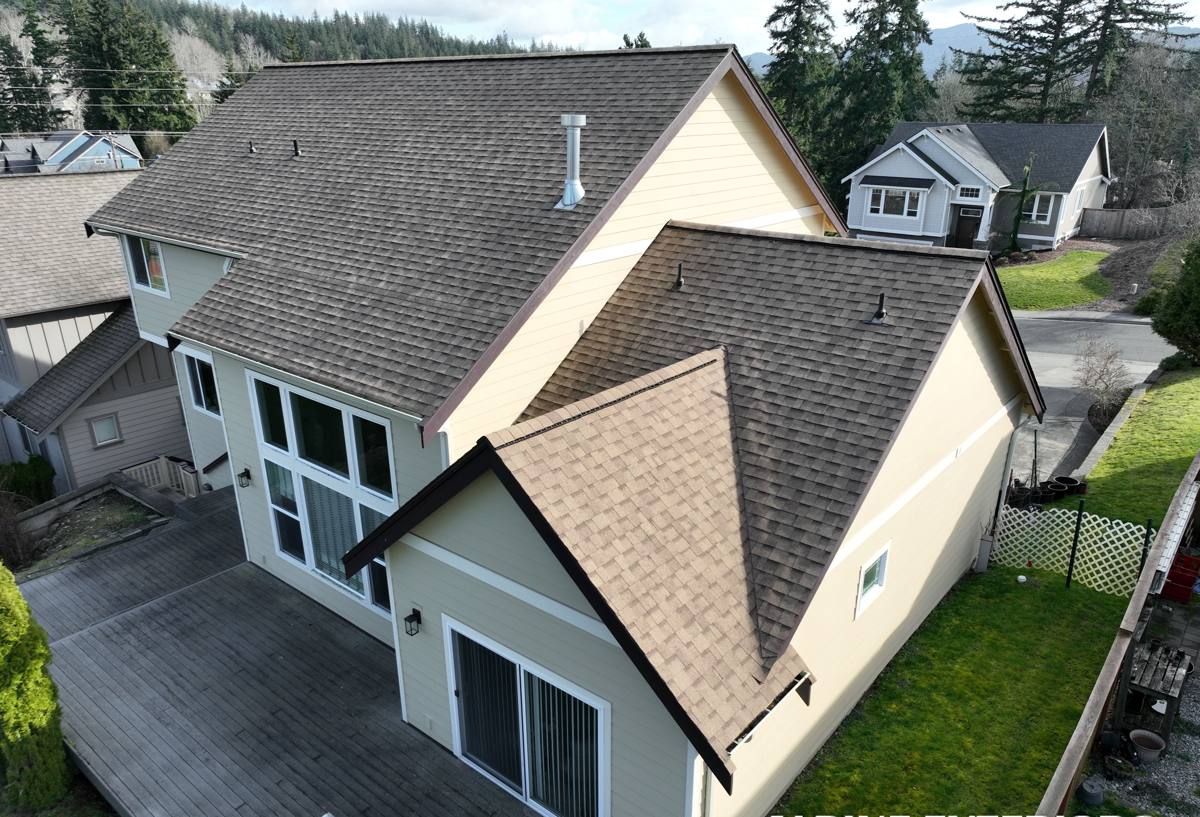
A lot of Ravenna's housing predates today's standard construction details. That means a siding job here isn't always a clean tear-off-and-replace on a modern wall assembly — it's common to find old, brittle building paper instead of proper housewrap, sheathing that's seen decades of moisture exposure, or trim and window openings that were never flashed to a modern standard in the first place. None of that is unusual for a crew that's used to working on older Seattle housing stock, but it does mean the job has to start with an honest look at what's actually behind the existing siding, not just an assumption that it's fine underneath.
Additions and remodeled sections are common too, which means a re-side sometimes has to reconcile two or three different wall ages and conditions on the same house. That's a planning problem as much as an installation one, and it's worth sorting out before crews start pulling old siding off the wall.
Why We Install Only James Hardie in This Neighborhood
We don't offer vinyl, LP SmartSide, Cemplank, Allura, primed spruce, or cedar. That's a deliberate standard, not a lack of options. Vinyl's lapped, non-sealed joints aren't built to shed wind-driven rain the way this area regularly delivers it. Engineered wood products depend on a factory coating and every field-cut edge staying sealed for decades in a climate where wet weather is the default. Cedar and primed spruce are real, appealing materials, but they're organic, combustible, and dependent on a paint or stain schedule that has to be kept up consistently — and moss finds an organic surface especially easy to take hold on in a climate that stays damp most of the year. Fiber cement as a category is the right direction; we standardized on James Hardie specifically because of how its climate-engineered product line, factory finish, and warranty structure work together.
The HZ5 Product Line
James Hardie engineers its siding for different climate zones, and the HZ5 line is built for regions with sustained moisture exposure and freeze-thaw cycling — a closer match to King County's winters than a product engineered primarily for hot, dry regions. That's a concrete, checkable reason for the choice, not a marketing distinction.
ColorPlus Factory Finish
Instead of relying on field-applied paint, Hardie's ColorPlus finish is baked on in a controlled factory environment, in multiple coats, before the boards reach the jobsite. It's backed by its own finish warranty separate from the substrate warranty and is formulated to resist fading and hold color better than paint applied on-site and left to cure in whatever weather shows up that week — a real variable in Seattle.
What a Correct James Hardie Installation Involves
Fiber cement's reputation depends heavily on installation quality. A rushed or out-of-spec install can undercut even the best material, which is why we treat these steps as non-negotiable rather than optional refinements:
- Remove old siding and inspect the sheathing and framing underneath for rot or existing water damage before anything new goes up
- Repair or replace any damaged sheathing, framing, or old flashing found during tear-off
- Install or correct the weather-resistive barrier, lapped correctly, before siding goes on
- Build in a drainage gap or rainscreen so any moisture that gets past the surface can dry out instead of sitting against the wall
- Maintain manufacturer-specified clearances at grade, roofline, and deck connections to keep splash-back and standing moisture off the board edge
- Use correct fastener type, placement, and depth to prevent cracking and preserve the water-resistive barrier
- Flash windows, doors, and penetrations so wind-driven rain sheds outward instead of collecting at seams
- Prime and seal any field-cut edges, since the factory ColorPlus finish only protects surfaces cut at the factory
Skip any of the steps involving flashing, drainage, or edge sealing and the wall can look fine for a season or two before problems start showing up where they're hardest to see.
James Hardie vs. Other Siding Options
| Material | Behavior in Ravenna's Climate | Maintenance | Realistic Lifespan |
|---|---|---|---|
| James Hardie fiber cement | Dimensionally stable; inorganic core doesn't swell, rot, or feed moss the way organic materials can | Low; factory finish resists fading and moss growth | 30+ years with correct install |
| LP SmartSide (engineered wood) | Performs well if every cut edge and fastener hole stays sealed; more sensitive to sustained moisture | Moderate; edge sealing needs periodic upkeep | 15-25 years, climate-dependent |
| Vinyl | Lapped joints aren't sealed against wind-driven rain; can warp under heat or cold cycling | Low, but hidden moisture behind panels is hard to catch | 20-30 years, variable |
| Cedar | Absorbs moisture at every seam and joint without a consistent paint or stain schedule | High; recurring repainting or resealing | 15-25 years with consistent upkeep |
The pattern across all three alternatives is the same: they can perform well, but the performance depends on ongoing maintenance staying on schedule in a climate that doesn't leave much room for it to slip. Hardie's inorganic core removes that dependency for the board itself.
Our Process for a Ravenna Siding Project
Walkthrough and Assessment
We start by walking the property and looking at what's actually there — which walls take direct weather, which are shaded and slow to dry under tree cover, and whether there's visible evidence of existing moisture problems that need addressing before new siding goes up. Re-siding over a wall with hidden rot just buries the same problem under new material.
Planning the Details Before Install Day
We work out flashing details, trim transitions, and how new siding will meet existing additions or mismatched wall sections before any material is cut. Sorting this out on paper first avoids field improvisation, which tends to be where corners get cut on a job.
Installation to Manufacturer Spec
Every fastener, gap, and flashing lap follows James Hardie's published installation requirements for this climate zone. That's what keeps the manufacturer's warranty intact and what determines whether the wall performs for decades rather than years.
Final Walkthrough
We walk the finished job with you, cover what little ongoing maintenance Hardie actually requires, and make sure you know what to look for if you ever want to check the wall yourself down the road.
Cost Factors for a Ravenna Siding Project
We won't quote a number without seeing the house, but the factors that move price from job to job are consistent:
| Factor | Why It Matters |
|---|---|
| Existing wall condition | Rot or old moisture damage found during tear-off adds repair work before new siding goes on |
| Home age and construction | Older Ravenna homes may need housewrap correction or reframing that a newer build wouldn't |
| Wall complexity | Dormers, additions, and multiple rooflines mean more corners, cuts, and flashing details |
| Product line and profile | Lap siding, panel, and shingle profiles differ in material and labor cost |
| Access and lot conditions | Tight lots, mature landscaping, or limited street access can add labor time |
| Trim and window count | More openings mean more flashing and finish work around each one |
Why Hire a Crew That Already Works Ravenna
Manufacturer installation instructions are written for a standard, newer-construction wall. A lot of Ravenna's housing stock doesn't match that description, and Seattle's weather doesn't leave much room for error when it doesn't. A crew that has actually opened up older Ravenna walls, found what's really behind the siding, and adjusted for it knows which parts of the manufacturer's guidance are non-negotiable in this climate and where extra time is worth spending even when it's not strictly required.
That experience shows up in decisions that rarely get discussed upfront — how much clearance a rainscreen gap needs on a heavily shaded, slow-to-dry wall, whether an old opening needs partial reframing rather than a shim-and-caulk fix, which orientations on a given lot need the most attention because of tree cover. Those choices decide whether a Ravenna home's siding is still performing cleanly in twenty years or showing moss staining and seam failures in five.
A Practical Checklist Before You Start
- Ask what's actually happening behind your current siding before assuming a simple like-for-like swap will work
- Confirm the contractor is a certified James Hardie installer, not just generally experienced with siding
- Ask specifically how they handle rainscreen gaps, fastener spec, and flashing at windows and doors
- Get a clear answer on what the substrate warranty and the ColorPlus finish warranty each cover, and whether they transfer to a future owner
- Ask how they plan to handle wall sections with different ages or prior additions
- Confirm WA contractor licensing and insurance before signing anything
Ready for a Free Estimate
If you're planning a re-side in Ravenna or elsewhere in Seattle, we're glad to walk the property, look at what's actually on the walls now, and give you a straight answer about condition, options, and realistic cost. Use the form below to schedule a free, no-pressure estimate.