 Seattle
 Queen Anne's Siding Takes a Different Kind of Beating
Queen Anne sits up on one of Seattle's steepest hills, and that elevation matters more than most homeowners realize when it comes to siding wear. Houses higher on the hill catch wind coming off Puget Sound with less tree cover and fewer neighboring buildings to break it up, which means driving rain gets pushed sideways into siding seams, trim joints, and butt joints that a lower, more sheltered home might never have to deal with. Add in Seattle's salt-tinged marine air and a moss season that can stretch from October through May, and you've got a neighborhood where siding ages on its own schedule.
The housing stock compounds it. Queen Anne has a lot of older homes — craftsman-era construction, additions and remodels layered on over decades, and original wood siding that's been painted, patched, and repainted more times than anyone can count. That history means repair work here is rarely a simple patch-and-go job. It usually involves figuring out what's underneath the visible damage before deciding what actually needs to happen.
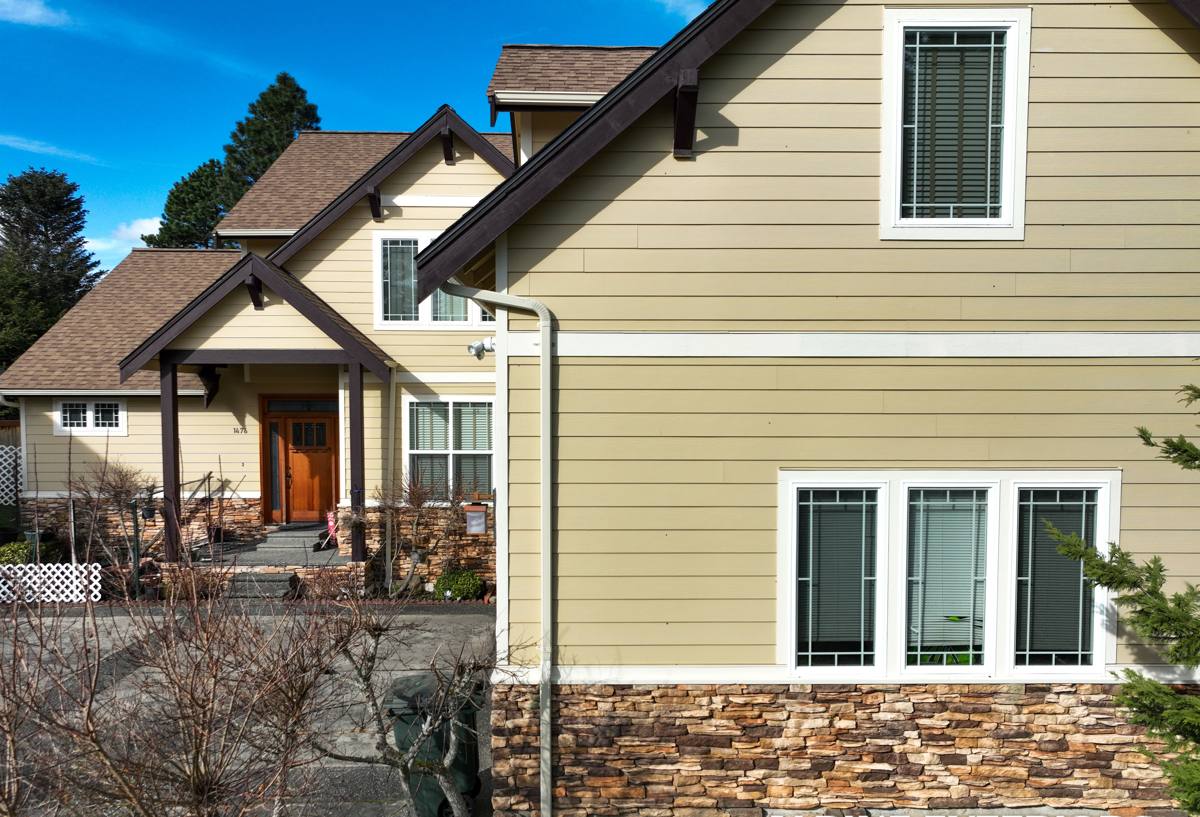
What Seattle's Climate Does to Siding Over Time
None of this is exotic — it's the same handful of mechanisms working slowly, year after year, until they show up as a problem.
Driving rain and wind-driven moisture
Rain that falls straight down mostly runs off siding the way it's designed to. Rain that gets pushed sideways by wind — which happens often on exposed, elevated lots — finds its way behind poorly sealed joints, under lifted caulk lines, and into any gap where two pieces of siding meet. Once moisture gets behind the siding plane, it doesn't dry out quickly in our climate, and that's where rot and delamination start.
Moss and prolonged dampness
Seattle's moss season isn't just a roof problem. Moss and algae colonize siding surfaces that stay damp for extended stretches, especially on north-facing walls and areas shaded by mature trees, which are common on Queen Anne's older, well-landscaped lots. Moss holds moisture directly against the siding surface, which accelerates paint failure on wood siding and can trap dampness against seams on any siding type.
Salt air and coastal exposure
Being close to the Sound means a low but steady dose of salt-laden air, which speeds up corrosion on exposed fasteners and metal flashing and can accelerate the breakdown of caulks and sealants over time. It's a slower process than what you'd see right on the waterfront, but it adds up over a 15- or 20-year span.
Temperature swings and material movement
Siding materials expand and contract with temperature and moisture changes. Repeated cycles loosen fasteners, open up caulk joints, and stress seams — which is often exactly where the leaks that lead to repair calls start.
Common Siding Repair Issues We See on Queen Anne Homes
| Siding Type | Typical Problem | What's Usually Driving It |
|---|---|---|
| Original wood lap siding | Rot at butt joints, paint failure, soft or spongy boards | Decades of moisture cycling, deferred repainting, moss holding dampness against the wood |
| Vinyl siding | Cracking, warping, panels popping loose | Wind exposure on elevated lots, UV and temperature cycling, brittle aging |
| Older fiber cement or hardboard | Swelling, edge deterioration, caulk failure at seams | Water intrusion at joints, especially where original caulking wasn't maintained |
| Trim and corner boards | Rot, peeling paint, gaps opening at the siding-to-trim transition | These are the first place wind-driven rain finds a way in |
What ties all of this together is that damage is rarely limited to what you can see from the ground. A stained or bubbled section of siding is often the visible edge of a wetter, softer area underneath — which is why an honest repair estimate starts with actually checking what's behind the surface, not just eyeballing it from the sidewalk.
What a Correct Repair Actually Involves
"Siding repair" covers a range of work, and the right scope depends entirely on what we find once we get into it. We generally see three tiers:
Spot repair
Replacing an isolated damaged board or small section, resealing joints, and repainting or color-matching as needed. Appropriate when the surrounding material is sound and the damage is contained.
Section replacement
Removing and replacing a run of siding — often an entire wall face or the area around a window, door, or corner — when moisture has spread beyond a single board. This is also the point where we check the water-resistive barrier and flashing details underneath, because siding that failed once at a given joint will usually fail again if the underlying moisture management isn't fixed too.
Full re-side
When damage is widespread, the siding is past its practical service life, or repeated repairs are chasing the same underlying problem across the whole house, replacing the siding entirely is often the more honest recommendation — even though it's a bigger job than a repair call. We'll tell you plainly when we think that's the case rather than patching something that's going to need patching again in two years.
Repair or Replace? What Actually Decides It
| Factor | Leans Toward Repair | Leans Toward Replacement |
|---|---|---|
| Extent of damage | Isolated to one or two areas | Recurring in multiple spots across the house |
| Underlying structure | Sheathing and framing are sound | Rot has reached the sheathing or framing |
| Age of existing siding | Well within expected service life | Original siding is decades old and failing broadly |
| Water-resistive barrier condition | Intact where checked | Compromised or original to a very old install |
| Repair history | First repair call in the area | Same wall has been patched more than once |
We won't push a full re-side when a targeted repair genuinely solves the problem, and we won't recommend a patch we don't think will hold. The goal is telling you what we actually find, not what's easiest to sell.
How Our Process Works
- On-site assessment. We walk the exterior, check the areas you've flagged, and probe for soft spots or hidden moisture beyond what's visible.
- Honest scope and estimate. You get a plain-language explanation of what's actually wrong, what tier of repair it calls for, and a written estimate before any work starts.
- Repair or replacement work. Damaged material comes out, the substrate and moisture barrier get checked and corrected if needed, and new material goes in properly flashed and sealed — not just caulked over.
- Finish matching. Where possible, we match paint or finish so the repair blends rather than standing out as a patch.
- Walkthrough. We go over the completed work with you before we consider the job done.
Because we work Queen Anne regularly, we already have a feel for how the hill's wind exposure and the neighborhood's mix of older and updated homes tend to show up in siding problems — which shortens the guesswork in the assessment phase.
When Replacement Material Is Needed: Why We Use James Hardie
When a repair calls for new siding material — whether it's a patched section or a full re-side — we install James Hardie fiber cement exclusively. We don't install vinyl, LP SmartSide, or primed wood siding, and that's a deliberate standard, not an oversight.
In a climate like Seattle's, the products we've moved away from each carry real trade-offs: vinyl can crack and warp under wind and temperature swings and doesn't hold paint if you ever want to change the color; primed wood siding requires disciplined, ongoing repainting to keep moisture out, which is exactly the maintenance gap that caused a lot of the damage we get called out to fix in the first place. James Hardie's fiber cement is non-combustible, holds up to sustained damp exposure far better than wood-based products, and comes with a factory-applied ColorPlus finish that's engineered to resist fading and doesn't require repainting on the same short cycle. It's also backed by a strong transferable warranty when installed to Hardie's specifications — which matters, because installation quality is what determines whether any siding product actually performs long-term.
If your repair only needs a small patch and matching your existing material is the more sensible call, we'll say so. But when new siding is going in, Hardie is what we stand behind.
Signs You Likely Need Siding Repair
- Soft, spongy, or bubbled sections when you press on the siding
- Paint that's peeling, cracking, or failing faster than the rest of the house
- Persistent moss or dark staining that keeps coming back after cleaning
- Visible gaps or separation at joints, corners, or trim boards
- Warped, cracked, or missing vinyl panels
- Water stains or damp spots on interior walls near exterior siding
- A musty smell near exterior walls, especially after heavy rain
- Siding that hasn't been inspected or maintained in five or more years
After the Repair: Keeping It From Happening Again
A repair is only as good as what happens after it. A few habits go a long way in this climate:
- Keep gutters clear so runoff isn't sheeting down siding faces during heavy rain
- Trim back vegetation that's shading siding and keeping it damp longer than it should be
- Rinse moss and algae growth off before it gets a strong foothold, rather than after
- Recheck caulk lines at joints and trim every couple of years — this is cheap to maintain and expensive to ignore
- Address small paint failures or soft spots early, before winter's rain has months to work on them
If you're in Queen Anne and dealing with siding that's showing its age — or you just want an honest read on whether a section needs a patch or a full re-side — we're happy to come take a look. Fill out the form below for a free, no-pressure estimate.