 Seattle
 Why Ravenna Decks Wear Out Faster Than Homeowners Expect
Ravenna is a shaded, tree-heavy neighborhood, and that's part of what makes it a nice place to live — mature canopy, quiet streets, older housing stock with real character. It's also exactly the kind of setting that's hard on an exterior deck. Overhanging trees mean more debris sitting on boards, more shade holding moisture after a storm, and more organic buildup feeding moss and algae. Add in the broader Puget Sound climate — driving rain through the fall and winter, salt-tinged marine air moving in off the Sound, and a moss season that can run half the year in King County — and a deck here is under a different kind of stress than one in a drier, sunnier climate.
None of that means a deck can't last. It means the deck has to be built and maintained with this climate in mind from the start. A lot of the deck problems we see in Ravenna trace back to a deck that was built correctly for a different climate, or repaired piecemeal for years instead of addressed at the structural level.
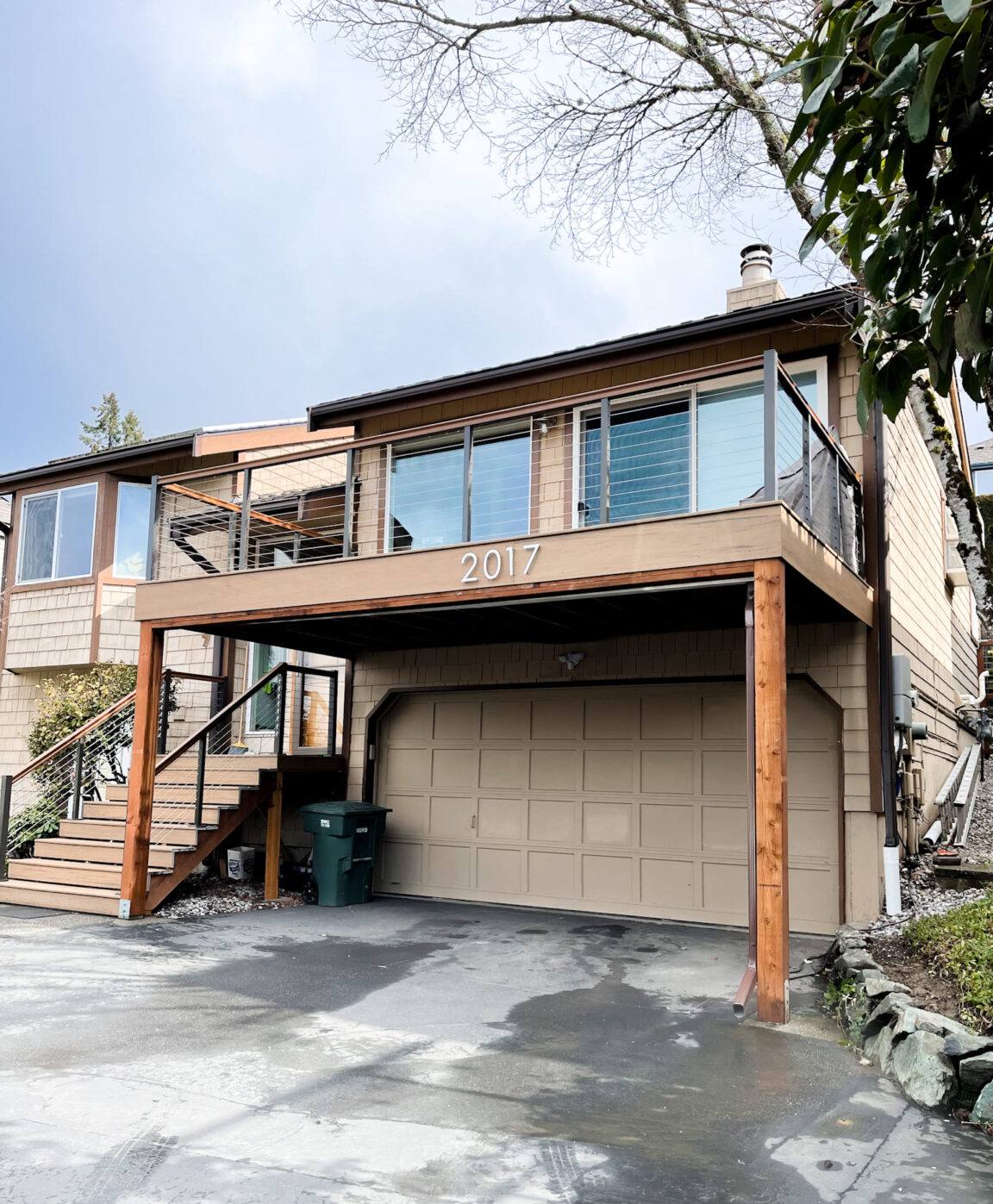
Signs a Ravenna Deck Needs Replacement, Not Another Repair
Homeowners often ask whether a deck can be patched instead of replaced. Sometimes yes — a few soft boards or a loose railing don't mean the whole structure is bad. But there's a point where repair stops being the honest recommendation. Here's how we tell the difference:
- Soft or spongy decking in more than one area, not just a single board near a downspout or planter
- Rot, rust, or corrosion at the ledger board — where the deck attaches to the house — since this is a structural connection, not a cosmetic one
- Wobble or movement in the railing posts, which often points to compromised framing underneath, not just a loose fastener
- Persistent moss or black-green staining that comes back within weeks of cleaning, suggesting the deck isn't draining or drying between rain events
- Visible daylight gaps, cupping, or splitting across most of the decking surface, which is normal wear reaching the end of a board's service life
- Undersized or corroded joist hangers and fasteners, especially on decks more than 15-20 years old built before current hardware standards
If it's one or two of these, repair is usually the right call and the honest one. If it's several at once, replacement is usually cheaper over a five-year horizon than chasing repairs on a structure that's already failing in more than one place.
What a Correct Deck Replacement Actually Involves
A deck replacement isn't just pulling up old boards and screwing down new ones. The decking surface is the part everyone sees, but it's the smallest part of what determines how long the deck lasts in a wet climate like ours.
The Ledger Board Connection
This is where the deck ties into the house framing, and it's the single most important structural detail on most residential decks. It needs proper flashing to keep water from tracking behind it into the house rim joist, correct fastening (not just nails, but load-rated lag screws or structural screws sized to code), and in many cases new flashing tape or metal flashing if the old connection was sealed with caulk alone — which fails over time in this climate.
Footings and Posts
Footings need to sit below frost depth and bear on undisturbed or properly compacted soil. In older Ravenna homes, it's common to find decks resting on undersized footings, or posts set directly in soil without a proper base, both of which lead to settling and the "bounce" homeowners sometimes feel when walking across a deck.
Framing and Fasteners
Joists, beams, and hardware all get evaluated and typically replaced as part of a full deck replacement. In a marine climate, we spec hot-dip galvanized or stainless hardware rather than standard coated fasteners, since standard hardware corrodes faster here — especially in a shaded, damp lot.
Drainage and Airflow
A deck that can't dry out between rain events will grow moss and mildew no matter what decking material sits on top. Correct joist spacing, gapping between boards, and keeping the underside of the deck ventilated all matter more in Seattle's climate than in drier regions.
Decking Material Options — Honest Trade-Offs
There's no single "best" decking material — there's a best material for a given budget, maintenance appetite, and how much shade and moss exposure the specific deck deals with. Here's how the main options compare for a Ravenna lot:
| Material | Upfront Cost | Maintenance in Our Climate | Typical Lifespan Here |
|---|---|---|---|
| Pressure-treated wood | Lowest | Annual cleaning and re-sealing needed to resist moss and rot | 10-15 years with upkeep |
| Cedar | Moderate | Natural rot resistance, but still needs regular sealing in shaded, damp spots | 15-20 years with upkeep |
| Composite decking | Higher | Low — occasional washing to keep moss from taking hold on the surface | 25-30 years |
| PVC/capped composite | Highest | Lowest — fully capped boards resist moisture absorption best | 25-30+ years |
Composite and capped PVC products cost more up front, but for a shaded, moss-prone lot they often make sense because they don't absorb moisture the way wood does, which is the main driver of rot and slip-hazard growth in this climate. That said, composite isn't maintenance-free — it still needs periodic washing, and installation quality (proper gapping, hidden fastener spacing, correct joist spacing for the specific product) matters as much with composite as with wood. A composite deck installed with wood-spec joist spacing will still sag and trap moisture.
Moss, Mildew, and What Actually Reduces It
Moss on a deck isn't just cosmetic — it holds moisture against the boards and creates a slip hazard on stairs and walking surfaces. The long moss season we get here means moss control has to be part of the design, not an afterthought:
- Board spacing that allows water to drain through rather than pool on the surface
- Decking oriented and, where possible, positioned to get some seasonal sun exposure rather than sitting in permanent shade
- Smooth-surface or grooved-edge composite boards, which tend to hold less organic debris than deep wood grain
- Keeping nearby vegetation trimmed back so airflow and light can reach the deck surface
- A realistic annual cleaning routine — pressure washing or a deck-safe cleaner in spring, before moss gets established for the wet months
Our Deck Replacement Process
We keep this straightforward because homeowners deserve to know what's happening at each stage, not just get a finished deck with no explanation:
- On-site evaluation of the existing deck — framing, ledger connection, footings, and decking condition — so the recommendation is based on what's actually there, not guesswork
- A written scope and estimate that separates structural work from surface material choice, so you can see where the cost is going
- Permit filing where required (see below) before any demolition starts
- Removal of the old deck, with an on-site check of framing and ledger condition once the old decking is off — this is often where we confirm or revise the original scope
- Structural rebuild: footings, framing, ledger flashing, and hardware brought up to current code
- Decking, railing, and stair installation using the material selected
- Final walkthrough covering maintenance expectations specific to the material installed
Permits and Code in Seattle and King County
Most deck replacements in Seattle require a permit, particularly when the work involves the structural framing, footings, or a deck attached at a certain height or size threshold. Permit requirements exist for a real reason on decks — inspectors are checking ledger attachment, footing depth, and guardrail/stair code compliance, which are exactly the failure points that cause injuries when skipped. A contractor who suggests skipping the permit step to save time or money is cutting a corner that shows up later, either at resale or in an insurance claim after a structural failure. We handle the permit process as a standard part of the job rather than an optional add-on.
Why a Crew That Already Works Ravenna Matters
A deck replacement is easier to get right the first time when the crew already understands the conditions in this specific area — the shade patterns, the drainage challenges on older Seattle lots, the way King County inspectors expect ledger and footing work to be documented, and which materials actually hold up under a long, wet moss season versus which ones just look good in a showroom. That local familiarity shows up in small decisions during the job: how the flashing gets detailed at the ledger, how footings get sized for the specific soil, which board spacing actually sheds water on a shaded lot. Those are the details that separate a deck that looks fine for two years from one that holds up for two decades.
What to Ask Before You Hire
- Will you pull the required permit, and can I see it filed before work starts?
- What hardware and fasteners are you using, and are they rated for a wet, marine climate?
- How will the ledger board be flashed, and can you explain why?
- What's your written warranty on labor, separate from the manufacturer's material warranty?
- Can I see the framing before decking goes down, or is that covered up without a check-in?
- What maintenance will this specific decking material actually need each year?
A contractor who answers these plainly, without getting defensive, is generally one worth hiring. Vague answers on permits or fasteners are a warning sign worth taking seriously.
If your Ravenna deck is showing its age or you're planning ahead for a replacement, we're happy to take a look and give you a straight answer on repair versus replacement — no pressure, no upsell. Use the form below to request a free estimate.