 Seattle
 Composite Decking Built for How Redmond Actually Weathers
Redmond sits in a part of King County that stays green for a reason — it rains a lot, humidity lingers under tree canopy and cloud cover for months at a time, and anything wood-based left outdoors has to fight moss, algae, and slow moisture intrusion nearly year-round. Composite decking was built to handle exactly that kind of exposure, which is why it's become the default choice for homeowners in this area who are tired of re-staining, sanding, and replacing boards every few years.
But "composite decking" isn't one product, and installing it correctly in a wet Pacific Northwest climate is not the same as installing it in a dry inland state. The framing underneath, the fastening system, the ventilation, and the drainage details all matter more here than they do in climates that don't see months of driving rain and low sun angles that never quite dry things out. This page covers what a Redmond composite deck actually needs, what our process looks like, and what to expect from a crew that works this specific area regularly.
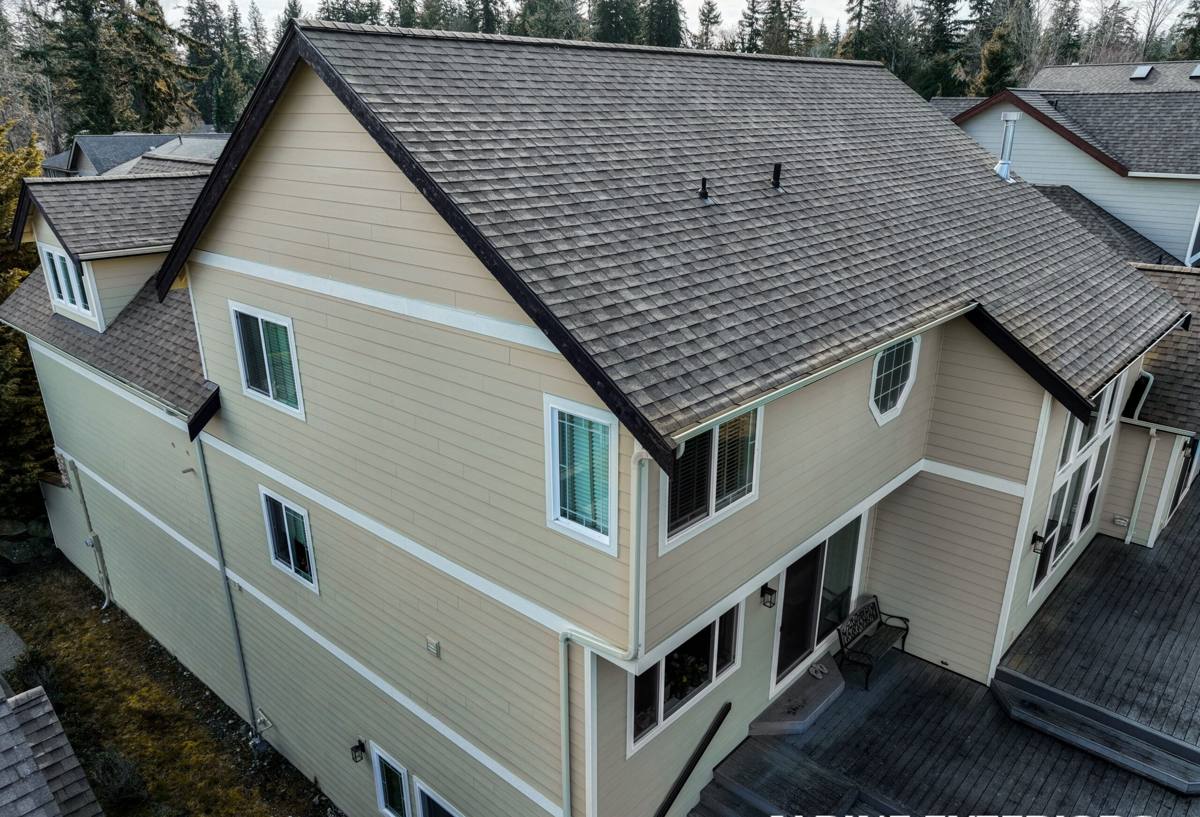
What Redmond's Climate Does to a Deck
Redmond doesn't get hit as hard by salt air as homes closer to Puget Sound, but it shares the same broader marine climate pattern that affects exterior work across the greater Seattle area: long stretches of driving rain, high ambient humidity, and a moss season that can run from fall through spring. A few things follow from that:
- Standing water and slow-draining surfaces stay wet longer here than in drier climates, which accelerates mold, algae, and moss growth on any surface that isn't shedding water efficiently.
- Shaded decks under mature trees — common on Redmond lots — see even less drying time between rain events, which is exactly where moss gets a foothold.
- Wood substructure that isn't properly ventilated or protected can trap moisture against joists and beams, leading to rot that shows up years later, often after the surface boards themselves look fine.
- Freeze-thaw cycles are mild but not absent — a few hard frosts a year are enough to stress any decking material that's already saturated with water.
None of this means composite decking is a bad fit — it's actually the opposite. Composite boards resist rot, don't need annual staining, and shed moss more easily than wood. The catch is that the framing, fasteners, and drainage details underneath the boards still have to be built for this climate, because that's usually where problems actually start.
What a Correct Composite Deck Installation Involves
Framing and Substructure
Composite boards are only as good as what's underneath them. In a climate like Redmond's, we pay close attention to joist spacing (often tighter than manufacturer minimums for composite, since composite has more flex than wood in wet-cold swings), proper flashing where the deck ties into the house, and moisture barriers between the ledger board and the structure. A deck that leaks at the ledger connection is one of the most common sources of hidden rot in this region, composite surface or not.
Ventilation and Drainage
Airflow underneath the deck matters as much as what's on top. We build in clearance and drainage paths so water and humid air don't sit trapped against the framing — this is one of the biggest differences between a deck that lasts and one that develops hidden problems after five or six wet seasons.
Fasteners and Hardware
We use fasteners and hidden clip systems rated for the specific composite board being installed, and we use corrosion-resistant hardware throughout. In a climate with this much sustained moisture, cutting corners on hardware is one of the fastest ways to end up with squeaks, board movement, or staining around fastener points a few years down the line.
Board Spacing and Expansion
Composite material expands and contracts with temperature and moisture more than most homeowners expect. Getting gap spacing right at installation — accounting for our wet winters and warmer, drier summers — prevents buckling and keeps seams tight over time.
Composite vs. Other Decking Materials in This Climate
| Material | How It Handles Redmond's Wet/Moss Climate | Ongoing Maintenance |
|---|---|---|
| Composite decking | Resists rot and moisture absorption well; still needs periodic cleaning to prevent surface moss/algae | Occasional wash-down; no staining or sealing |
| Pressure-treated wood | Vulnerable to moss, splintering, and rot if not sealed regularly, especially in shaded areas | Annual or biannual staining/sealing required |
| Cedar | Naturally rot-resistant but still needs consistent upkeep in sustained wet conditions | Regular oiling/sealing; soft surface can weather unevenly |
| PVC decking | Fully moisture-resistant, but can look and feel less like natural wood; more sensitive to installation temperature | Minimal; occasional cleaning |
We install composite decking as our standard recommendation for most Redmond projects because it strikes a practical balance: strong moisture resistance without the maintenance burden of wood, at a price point most homeowners find reasonable compared to PVC. That said, the right material always depends on the specific deck, its sun/shade exposure, and the homeowner's maintenance tolerance — we'll walk through the honest trade-offs during your estimate rather than pushing one product for every job.
Our Process
- On-site assessment. We look at your existing deck or build site, note drainage patterns, shade exposure, and any structural concerns before recommending an approach.
- Design and material selection. We walk through board options, color, and layout, and explain the trade-offs of each so you're choosing based on real information, not a sales pitch.
- Permitting. Deck projects in King County jurisdictions often require permits depending on size and height — we handle that process so you don't have to chase it down yourself.
- Demolition (if applicable) and framing. Old decking is removed, and the substructure is inspected, repaired, or rebuilt to current standards before any composite board goes down.
- Installation. Boards are installed with correct spacing, hidden fastening where specified, and attention to drainage and ventilation throughout.
- Final walkthrough. We go over the finished deck with you, including basic care so it holds up through Redmond's wet seasons.
Keeping a Redmond Composite Deck Looking Good Year-Round
Composite decking is low-maintenance, not no-maintenance. A few habits go a long way in this climate:
- Sweep off leaves and organic debris regularly, especially in fall — trapped wet leaves are one of the main causes of surface staining and moss growth.
- Rinse the deck with a hose or low-pressure wash a few times a year, more often in shaded areas, to keep moss and algae from getting established.
- Avoid high-pressure power washing directly on composite boards, which can damage the surface texture over time — a soft-bristle brush and mild soap handle most buildup safely.
- Check that gaps between boards and around the deck perimeter stay clear so water keeps draining as designed.
- Trim back overhanging branches where possible to let more light and airflow reach the deck surface.
What Affects the Cost of a Composite Deck
| Factor | Why It Matters |
|---|---|
| Deck size and shape | More square footage and complex layouts (angles, multiple levels) increase material and labor time |
| Board tier and brand | Composite lines range from entry-level to premium capped boards with longer warranties and better fade resistance |
| Substructure condition | Rebuilding rotted or undersized framing adds cost but is not optional if the existing structure isn't sound |
| Railing and stairs | Composite or metal railing systems, plus any stair construction, are priced separately from the deck surface itself |
| Site access | Sloped Redmond lots or limited equipment access can add labor time for material handling and demolition |
We won't quote a number without seeing the site, but we'll give you a clear, itemized estimate that separates material choice from labor and framing work, so you understand exactly what you're paying for.
Why Hire a Crew That Already Works Redmond
A deck built by a crew unfamiliar with this region's rain patterns and moss cycles can look fine the first summer and start showing problems by the third wet winter. We work throughout the greater Seattle area, including Redmond, and we build framing, drainage, and ventilation details around what this climate actually does to a structure over years, not just what a manufacturer's spec sheet assumes for a generic install. That local familiarity — knowing which details matter here and which don't — is often the difference between a deck that needs attention in five years and one that doesn't.
If you're planning a new composite deck or replacing an aging one, we're happy to walk the site with you and put together a free, no-pressure estimate. There's no obligation — just a straight assessment of what your project needs and what it will cost. Use the form below to get started.