 Seattle
 Bellevue's Climate Is Harder on Windows Than It Looks
Bellevue doesn't get the harsh freezes or hailstorms that wreck windows in other parts of the country, and that's exactly why so many homeowners here underestimate what the local climate does over time. The damage isn't dramatic — it's slow. Nine months of low-intensity rain, long stretches of overcast humidity, and driving wind off the Sound work into every gap, seal, and joint a window has. Add the tree cover that gives so many Eastside neighborhoods their character, and you get shade, moisture, and organic debris sitting against siding and trim for weeks at a time. Moss doesn't just grow on roofs here — it establishes on window sills, sashes, and frame corners that stay damp and shaded, especially on the north and west sides of a house.
None of this is a defect in your home. It's just what King County weather does to building materials that weren't installed with drainage and sealing details specific to this region. A window that would perform fine in a drier climate can fail early here if the flashing, sealants, or frame material weren't chosen and installed with Pacific Northwest moisture in mind.
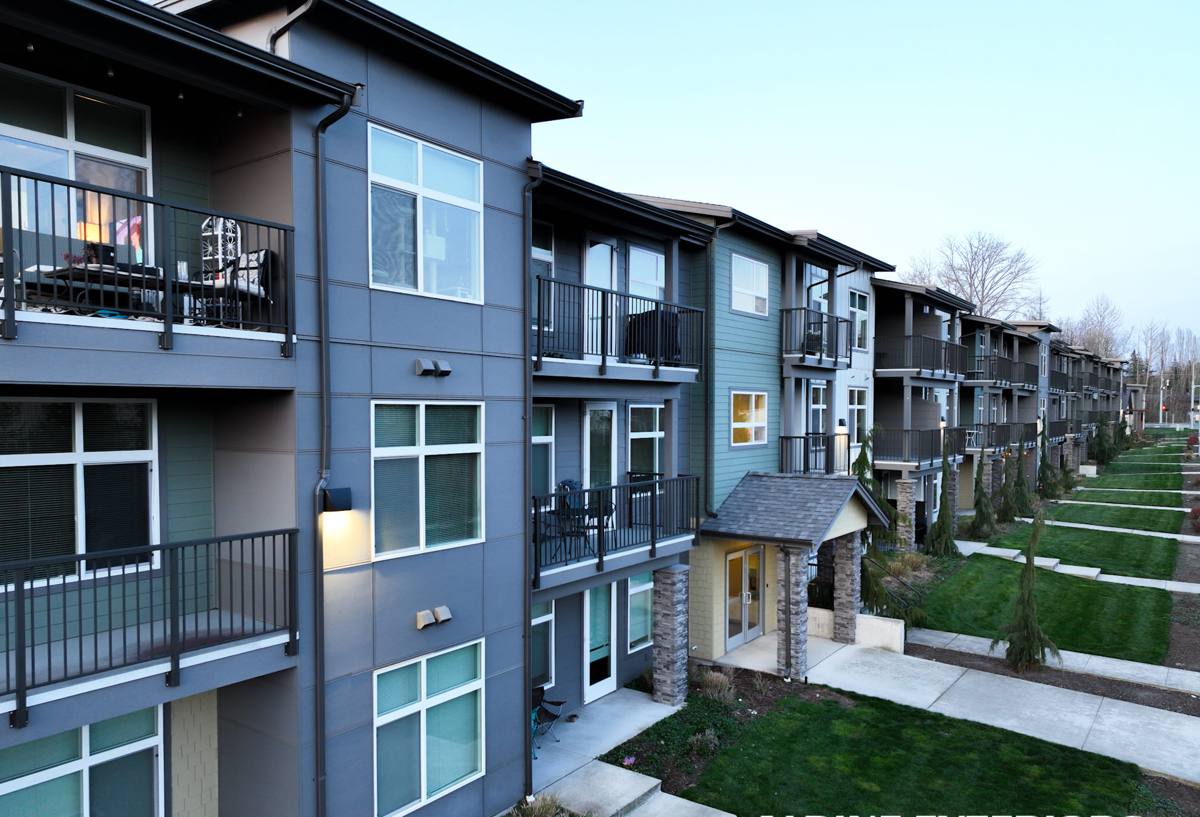
Signs Your Bellevue Home's Windows Are Ready for Replacement
Most window failures show up gradually, and homeowners often adjust to them without realizing how much comfort and energy they're losing. Watch for:
- Fogging or a permanent haze between panes — the seal has failed and the gas fill is gone
- Soft or discolored wood at the sill or bottom corners, often with moss or dark staining nearby
- Windows that are noticeably harder to open, close, or lock than they used to be
- Drafts you can feel by holding a hand near the frame on a windy day
- Visible daylight or gaps around the frame when the sash is closed
- Condensation forming on the inside glass regularly, especially in cooler months
- Paint or finish that's peeling or bubbling specifically around the window opening, not the rest of the wall
Any one of these can usually wait for a planned replacement. Soft wood at the sill or staining that's spreading into the wall framing is the one that shouldn't — moisture intrusion behind a window compounds quickly in a climate this wet.
What a Correct Window Replacement Actually Involves
The window unit itself is only part of the job. In a climate that sees this much sustained moisture, how the opening is prepared and sealed matters as much as what you buy. A correct installation includes:
Removing and Inspecting the Opening
Once the old window is out, we check the sheathing, sill, and framing for rot or hidden moisture damage before anything new goes in. This is often where a homeowner learns whether a past leak was ever actually addressed or just covered over. Installing a new window over a compromised opening just traps the problem behind new trim.
Flashing and Drainage
Every window opening needs a path for water that gets past the exterior cladding to drain back out, not into the wall cavity. That means proper sill pan flashing, correctly lapped house wrap, and flashing tape sequenced so water always sheds outward and downward — never trapped behind the window. This detail is the single biggest predictor of whether a window leaks in five years or in twenty-five.
Sealing and Insulating
Low-expansion foam or backer rod and sealant around the frame perimeter closes air gaps without bowing the frame out of square. Exterior sealant joints need to be compatible with your siding material and rated for exterior exposure, not just any caulk on hand.
Interior and Exterior Finish
Trim, casing, and paint or caulk lines get finished so the new window looks original to the house, not bolted in. On the exterior, this also means restoring the drainage plane so the wall assembly performs the way it did before we started.
Choosing Materials That Hold Up in This Climate
There's no single "best" window material — it depends on your home's style, your budget, and how much upkeep you want to take on. Here's how the common options actually perform under sustained Pacific Northwest moisture and gray-sky UV exposure:
| Material | Moisture Performance | Maintenance | Typical Lifespan |
|---|---|---|---|
| Vinyl | Won't rot; seams and welds need to be well-made to stay watertight long-term | Low — occasional cleaning | 20–30 years |
| Fiberglass | Excellent — dimensionally stable, doesn't swell or warp with humidity swings | Low | 30–40+ years |
| Wood (unclad) | Attractive but requires diligent finish maintenance to resist rot in this climate | High — refinishing on a cycle | Varies widely with upkeep |
| Wood-clad (aluminum or fiberglass exterior) | Good — exterior shell protects the wood core from direct weather | Moderate | 25–35 years |
| Aluminum | Durable but conducts cold and is prone to interior condensation without a thermal break | Low | 20–30 years |
We install fiberglass and quality vinyl on most Bellevue projects because they hold up to sustained damp weather without the finish maintenance that unclad wood demands. For homeowners who want a wood interior look, wood-clad units give you that appearance with a weather-resistant exterior shell doing the actual work of shedding rain. We're upfront when a lower-maintenance material is the more honest long-term choice for a given home, even if it's not the flashiest option.
Full-Frame vs. Insert Replacement — Which Your Home Needs
There are two basic approaches to replacing a window, and the right one depends on the condition of what's already there.
Insert (Pocket) Replacement
The new window is built to fit inside the existing frame, which stays in place. This is faster, less disruptive to interior and exterior finishes, and often costs less. It's a good option when the existing frame and sill are still structurally sound and dry.
Full-Frame Replacement
The entire window, including the old frame, is removed down to the rough opening. This costs more and takes longer, but it's the only correct option when there's rot, water damage, or a frame that's out of square — which we see often in Bellevue on older homes where a leak went unaddressed for years. Full-frame replacement is also the right call when you're changing window size or style, since it exposes the full opening for proper flashing.
We'll tell you honestly which one your home needs after inspecting the actual condition of the opening — not just quote whichever is easier to sell.
Our Process, Start to Finish
- Free on-site assessment. We look at your current windows, check for hidden moisture or framing issues, and talk through your priorities — energy performance, noise, style, or budget.
- Honest recommendation. We tell you whether insert or full-frame replacement fits your situation, and which materials make sense for your home and exposure.
- Written estimate. Clear scope, materials, and pricing — no vague allowances.
- Scheduled installation. Most homes are done in a matter of days, not weeks, with the work area protected and cleaned up daily.
- Final walkthrough. We check operation, sealing, and finish work with you before calling the job done.
Energy Performance and Moisture Control
In a climate defined more by persistent damp and moderate temperatures than by extreme heat or cold, the window performance numbers that matter most are U-factor (how well it resists heat loss) and condensation resistance, more than solar heat gain, which matters more in sunnier climates. A well-sealed, properly installed window keeps interior humidity from condensing on cold glass and sitting in the frame track — which is exactly the kind of standing moisture that feeds mold and, eventually, rot. Poorly sealed old windows are also a major contributor to the drafty, hard-to-heat rooms that show up in older Eastside homes during our wetter, cooler months.
Replacing single-pane or failed double-pane windows with correctly installed, properly sealed units is one of the more noticeable comfort upgrades a homeowner can make, both in reduced drafts and in a quieter interior — helpful if your home is anywhere near busier Bellevue streets or under a flight path.
Why Hiring a Crew That Already Works in Bellevue Matters
Window replacement done wrong doesn't usually fail on day one — it fails in year three or four, when a poorly flashed opening finally lets water into the wall. A crew that works across King County regularly sees how that failure happens here specifically: which orientations take the most weather, how moss and organic debris build up around frames under tree canopy, and how local permitting and inspection expectations apply to window replacement projects in Bellevue. That local repetition is what turns "installed a window" into "installed a window that's still watertight a decade later."
We also know the practical side of working in established Bellevue neighborhoods — respecting property lines and landscaping, coordinating around HOA expectations where they apply, and keeping a job site clean and predictable in neighborhoods where people are home during the day.
Questions to Ask Before You Hire
A little vetting up front saves a lot of frustration later. Before signing with any window contractor in the Bellevue area, ask:
- Do you use insert or full-frame replacement, and how do you decide which my home needs?
- What flashing and sealing method do you use, and is it suited for this climate specifically?
- Are your installers employees or subcontractors, and who's actually on my job site?
- What's covered under warranty — the window manufacturer's warranty, your installation warranty, or both?
- Can you show me examples of full-frame replacements where you found and fixed hidden rot?
- How do you handle disposal of old windows and job-site cleanup?
- What's the realistic timeline from signed estimate to completed installation?
A contractor who answers these clearly and specifically, without dodging into a sales pitch, is generally one worth trusting with your home.
If your Bellevue home's windows are drafty, fogged, showing soft wood, or just overdue, we're happy to take a look and give you a straight assessment — no pressure, no obligation. Use the form below to request a free estimate and we'll get back to you with next steps.