 Seattle
 Why Magnolia Homes Wear Out Siding Faster
Magnolia sits on a peninsula, with water on three sides and elevation changes that funnel wind straight off Puget Sound. That combination means homes here take on a mix of stresses that inland Seattle neighborhoods don't deal with in the same way: salt-laden air drifting up from the water, wind-driven rain that hits siding at an angle instead of falling straight down, and a long, damp shoulder season that keeps north-facing walls and shaded siding wet for weeks at a stretch. None of that is unique to any one block in Magnolia — it's a function of the peninsula's exposure, and it shows up on siding of every age and style across the neighborhood.
Salt air is corrosive to fasteners and hard on paint film over time, even at a few miles from open water. Wind-driven rain finds its way into laps, seams, and butt joints that would stay dry in calmer weather. And King County's mild, wet winters mean moss and algae get a long runway to establish themselves on siding, trim, and anything shaded by mature trees — which much of Magnolia has in abundance.
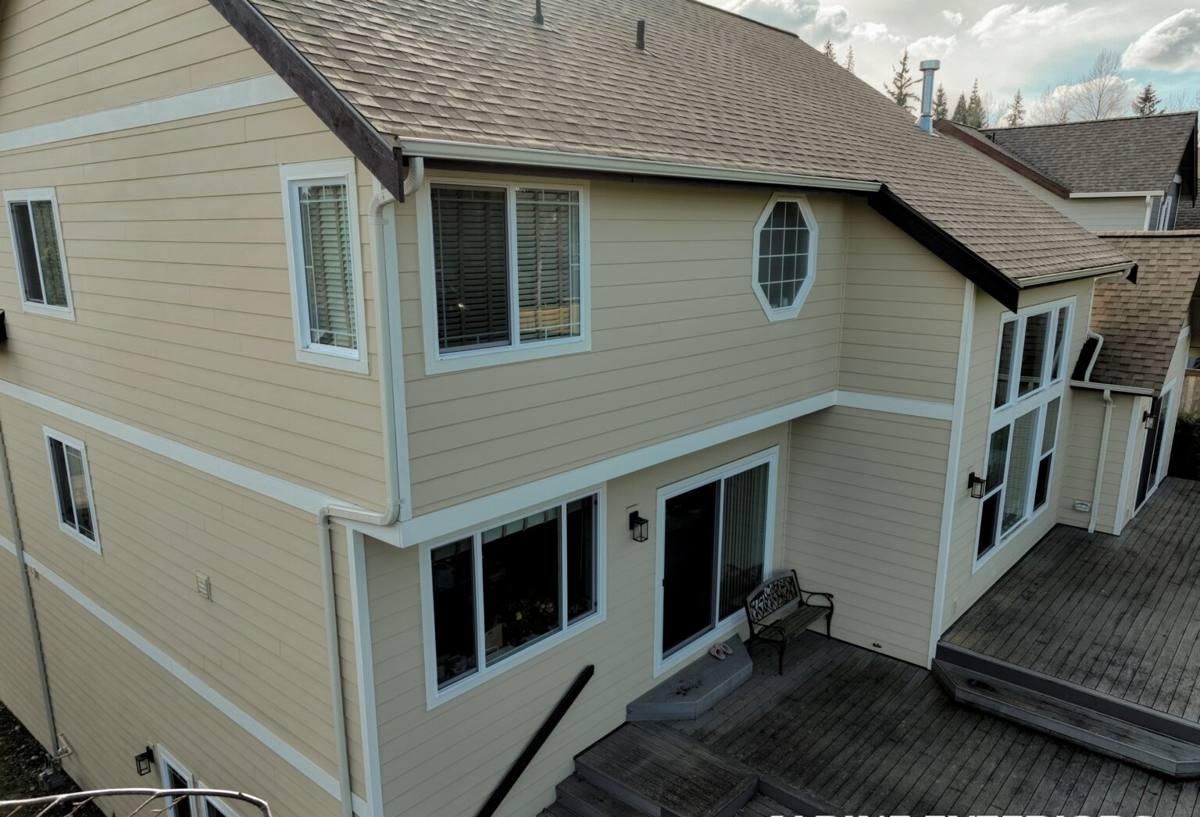
What This Climate Does to Different Siding Types
Wood and wood-composite siding are the most exposed to Magnolia's conditions. Once moisture gets past a compromised paint film or a failed caulk joint, wood siding holds water, and holding water is what starts rot. Vinyl siding handles rain reasonably well on its face but relies entirely on the water-resistive barrier behind it to manage anything that gets past the laps — and in wind-driven rain, more gets past the laps than most homeowners expect. Vinyl also chalks and fades faster under UV and salt exposure than most homeowners expect going in.
This is the core reason we standardized on James Hardie fiber cement siding and don't install LP SmartSide, vinyl, Cemplank, Allura, primed spruce, or cedar. It's not that those products can't be installed correctly — it's that fiber cement's moisture behavior and factory-cured finish hold up better, with less maintenance, in exactly the conditions Magnolia sees every winter.
Why Fiber Cement Fits This Peninsula
- Non-combustible material — a real advantage anywhere with dry summer wildfire smoke and ember exposure, which the greater Seattle area has seen more of in recent years
- Doesn't absorb and hold water the way wood-based products can, which matters on a peninsula with a long wet season
- ColorPlus factory finish is baked on and warranted against peeling and fading, instead of relying on field-applied paint that a house here will need to redo every several years regardless of siding type
- James Hardie's HZ5 product line is engineered for the Pacific Northwest's moisture and temperature swings specifically, not a one-size-fits-all national spec
Signs Magnolia Homeowners Should Watch For
Because the climate here is harder on siding than a typical inland lot, problems tend to show up in predictable places first: north- and west-facing walls, areas under mature tree canopy, and anywhere close to grade where splash-back keeps siding wet longer.
| What You See | What It Usually Means |
|---|---|
| Persistent moss or green film on siding | Chronic moisture retention — surface may be fine, or may be masking a wetter panel underneath |
| Soft or spongy spots when pressed | Water has gotten past the face and into the substrate — common on wood and wood-composite siding |
| Paint peeling in sheets rather than fading evenly | Moisture pushing out from behind the paint film, not just UV wear |
| Visible gaps at butt joints or corners | Caulk and sealant failure, an entry point for wind-driven rain |
| Bubbling or rippling on flat panel sections | Trapped moisture behind the panel, often tied to a failed or missing water-resistive barrier |
What a Correct Siding Replacement Actually Involves
Replacing siding is not just swapping old panels for new ones. On a Magnolia home, where wind-driven rain and long wet stretches are the norm, the details behind the siding matter as much as the siding itself.
Full Tear-Off, Not Overlay
We remove the existing siding down to the sheathing rather than installing over it. Overlaying traps whatever moisture or damage is already there, and it hides problems instead of fixing them. A full tear-off is the only way to actually inspect the sheathing and framing underneath.
Sheathing Inspection and Repair
Any sheathing that's soft, delaminated, or water-stained gets replaced before new siding goes on. Installing new siding over damaged sheathing just resets the clock on the same problem.
Water-Resistive Barrier
A correctly lapped and sealed weather-resistive barrier is what actually keeps wind-driven rain out of the wall assembly — the siding itself is the first line of defense, not the last. This is the layer that matters most in a peninsula climate like Magnolia's.
Flashing at Every Penetration
Windows, doors, hose bibs, vents, and any other wall penetration need proper flashing integrated with the water-resistive barrier. This is where a rushed job shows up as a leak two winters later.
Correct Fastening and Clearances
James Hardie specifies fastener type, spacing, and minimum clearance from grade, decks, and roof lines for a reason — those clearances keep splash-back and standing water away from the bottom edge of the siding, which is the most vulnerable point on any installation.
Our Process on a Magnolia Job
- Assessment — we walk the exterior, check problem areas first (north walls, shaded sections, anywhere near grade), and give an honest read on what's driving the wear.
- Prep and protection — landscaping, walkways, and neighboring surfaces get protected before tear-off starts.
- Tear-off and sheathing repair — old siding comes off, sheathing gets inspected, and any damaged sections are replaced.
- Water-resistive barrier and flashing — installed and sealed to manage wind-driven rain, not just vertical rainfall.
- James Hardie installation — panels or lap siding installed to manufacturer spec, including fastening pattern and clearances.
- Trim and detail work — corners, trim boards, and joints finished so water has nowhere to collect.
- Final walkthrough — we go over the finished exterior with you before calling the job done.
What Drives Cost on a Magnolia Siding Job
| Factor | Why It Matters |
|---|---|
| Home size and story count | More square footage and taller walls mean more material and more labor, including access equipment for multi-story homes |
| Existing siding type | Wood and wood-composite tear-offs often reveal hidden sheathing damage that adds repair time |
| Trim and architectural detail | Homes with more corners, dormers, and trim transitions take more time to finish correctly than a simple rectangular elevation |
| Site access | Steep lots, narrow driveways, and limited staging space — common on Magnolia's hillier streets — can affect equipment and labor logistics |
| Moisture damage found during tear-off | Rot repair to sheathing or framing is a real cost driver that can't always be quoted precisely until the old siding is off |
Because sheathing condition often can't be fully known until tear-off, an honest quote should include a clear process for what happens if hidden damage turns up — not a flat number that ignores the possibility.
Choosing a Crew That Actually Works This Neighborhood
Siding installation is detail-sensitive work, and a crew that regularly works Magnolia's peninsula conditions has already seen how wind-driven rain and long wet seasons expose shortcuts. That's worth more than a lower bid from a crew that mostly works drier, more sheltered lots elsewhere in King County.
- Ask whether they perform a full tear-off or will overlay existing siding
- Ask what water-resistive barrier and flashing details they use, and whether they follow the manufacturer's published installation instructions
- Confirm they're a factory-certified installer for the siding brand they're proposing
- Ask how they handle unexpected sheathing damage found during tear-off, and get that process in writing
- Ask about warranty coverage — both the manufacturer's product warranty and the installer's workmanship warranty
- Check that fastening, clearance, and flashing details match what the manufacturer actually specifies, not a generic industry shortcut
Maintenance After Installation
Correctly installed James Hardie siding needs very little upkeep, but a peninsula climate still calls for basic attention: rinse off moss and algae buildup periodically, especially on shaded or north-facing walls, and do a visual check of caulking at trim and penetrations every year or two. That's a fraction of the maintenance wood or vinyl siding demands in the same conditions.
If you're seeing moss buildup, soft spots, or peeling paint on your Magnolia home's siding, we're happy to take a look and give you a straightforward, no-pressure assessment of what's actually going on and what it would take to fix it right. Reach out below for a free estimate.